
Impressionism — Topic Guide
Impressionism was an artistic movement that emerged in France during the second half of the nineteenth century. Its painters sought to represent the immediate sensations produced by light, colour, and atmosphere rather than reproduce every detail with precision. They moved away from the rules of academic art and favoured scenes of modern life, landscapes, and fleeting moments. Their way of painting, initially harshly criticized, permanently transformed the history of art.
The Artistic Context of the Nineteenth Century
-
In the mid-nineteenth century, the Académie des beaux-arts exercised considerable influence over French painting.
-
The official Paris Salon was then the main exhibition where artists could gain recognition and sell their works.
-
The Salon juries favoured large historical, mythological, religious, and allegorical paintings.
-
Works were generally expected to display precise drawing, clearly defined forms, and a smooth surface with few visible brushstrokes.
-
Landscapes and scenes of everyday life were considered less prestigious than major historical subjects.
-
Several young artists gradually rejected these conventions and wanted to paint the contemporary world as they perceived it.
-
The modernization of Paris, the expansion of railways, new leisure activities, and the growth of the middle class provided painters with new subjects.
The Origins of the Movement
-
Impressionism developed mainly during the 1860s and 1870s.
-
Certain Realist and landscape painters, such as Gustave Courbet, Camille Corot, and the artists of the Barbizon School, prepared the way by depicting ordinary subjects and nature.
-
Édouard Manet played an essential role in the renewal of painting, although he did not participate in the Impressionist exhibitions.
-
His works often depicted contemporary figures and used bold contrasts that shocked part of the public.
-
In 1863, the large number of works rejected by the official Salon led to the organization of the Salon des Refusés.
-
This exhibition allowed the public to discover works that did not meet the Academy’s standards.
-
Claude Monet, Pierre-Auguste Renoir, Alfred Sisley, and Frédéric Bazille met in the studio of painter Charles Gleyre.
-
These artists began working together and painting directly outdoors.
The Birth of the Word “Impressionism”
-
In 1874, a group of artists organized an independent exhibition in the former Paris studios of photographer Nadar.
-
This first exhibition included Claude Monet, Edgar Degas, Pierre-Auguste Renoir, Camille Pissarro, Berthe Morisot, and Alfred Sisley.
-
The artists wanted to present their works without depending on the jury of the official Salon.
-
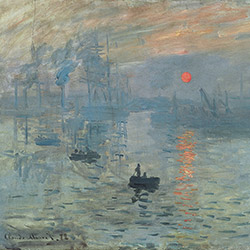
Claude Monet exhibited a painting titled Impression, Sunrise, depicting the port of Le Havre in hazy light.
-
The critic Louis Leroy mocked the title of the work and used the word “Impressionists” to ridicule the exhibitors.
-
The term, initially derogatory, was later adopted to designate the movement.
-
Eight Impressionist exhibitions were organized between 1874 and 1886.
The Main Characteristics
-
Impressionist painters sought to capture an immediate visual impression.
-
They often depicted a specific time of day, an atmospheric condition, or a particular effect of light.
-
Outlines were frequently less precise than in academic painting.
-
Forms were suggested through colour and brushstrokes rather than defined by sharp lines.
-
Brushstrokes remained visible and gave the paintings a spontaneous appearance.
-
The works could seem unfinished to a public accustomed to the smooth surfaces of official painting.
-
Compositions often gave the impression of showing a moment captured on the spot.
-
Figures were not always placed at the centre and could be partially cut off by the edges of the painting.
Light and Colour
-
Light was one of the Impressionists’ main concerns.
-
The artists observed that the colour of an object changed according to the time of day, the season, the weather, and its surroundings.
-
They generally avoided using pure black to represent shadows.
-
Shadows could be composed of blue, violet, green, or other colours reflected by the environment.
-
Colours were often applied side by side rather than fully mixed on the palette.
-
From a certain distance, the viewer’s eye visually combined the different touches of colour.
-
Contrasts between complementary colours, such as blue and orange, made scenes appear more luminous.
-
The development of new industrial pigments allowed artists to use a wider and brighter range of colours.
Painting Outdoors
-
Impressionists frequently painted directly outdoors rather than completing their landscapes entirely in the studio.
-
Paint in metal tubes, which was easier to transport, encouraged this practice.
-
Portable easels also allowed artists to work in fields, gardens, streets, and beside the water.
-
Railways made it easier to travel to the countryside and leisure destinations around Paris.
-
Artists had to work quickly to capture constantly changing light.
-
This speed contributed to the use of short, visible brushstrokes.
-
A work could nevertheless be started outdoors and later reworked in the studio.
The Subjects Depicted
-
Impressionists were interested in landscapes, rivers, gardens, and seasonal changes.
-
They also depicted boulevards, railway stations, bridges, and the new districts of Paris.
-
Cafés, theatres, dances, restaurants, and racecourses illustrated the leisure activities of modern society.
-
Scenes of bathing, boating, and strolling reflected the growth of outdoor recreation.
-
Artists often depicted members of the middle class, as well as workers, dancers, waitresses, and laundresses.
-
The subjects did not necessarily tell a precise story and could simply show an ordinary moment.
-
Everyday life therefore became an artistic subject as valid as historical or mythological narratives.
Claude Monet
-
Claude Monet was one of the central figures of Impressionism.
-
He was primarily interested in representing changes in light and atmosphere.
-
He often painted the same subject several times at different hours or during different seasons.
-
His series devoted to haystacks, poplar trees, and Rouen Cathedral explored variations in light.
-
In Giverny, he created a garden with a pond, a Japanese bridge, and water lilies.
-
Water lilies became the subject of numerous paintings during the final decades of his life.
-
In some late works, forms became less distinct and anticipated artistic research approaching abstraction.
Pierre-Auguste Renoir
-
Pierre-Auguste Renoir was especially known for his portraits and scenes of leisure.
-
He frequently depicted groups gathered in cafés, gardens, or places of entertainment.
-
His paintings used warm colours and gave great importance to the effects of light on faces and clothing.
-
Dance at Le Moulin de la Galette shows a crowd enjoying an afternoon dance in Montmartre.
-
Renoir was particularly interested in the human figure and the expression of the joy of life.
-
He later adopted a more classical style, with more solid forms and more precise outlines.
Edgar Degas
-
Edgar Degas was associated with Impressionism, but he preferred to describe himself as a Realist or independent artist.
-
Unlike several other members of the group, he worked mainly in the studio.
-
He depicted dancers, musicians, women bathing, jockeys, and scenes from performances.
-
His works often showed backstage areas, rehearsals, and ordinary moments rather than official performances.
-
His compositions used unusual angles, off-centre framing, and figures partially cut off.
-
Degas produced paintings, drawings, pastels, prints, and sculptures.
-
His interest in movement led him to repeat certain gestures and positions in many works.
Camille Pissarro and Alfred Sisley
-
Camille Pissarro was the only artist to participate in all eight Impressionist exhibitions.
-
He painted rural landscapes, villages, roads, and scenes of agricultural work.
-
He also depicted urban views, particularly the boulevards of Paris seen from elevated windows.
-
Pissarro played an important role in maintaining the unity of the group and encouraged several younger artists.
-
Alfred Sisley devoted himself mainly to landscape painting.
-
He often depicted rivers, villages, floods, roads, and snowy landscapes.
-
His works gave an important place to the sky and to atmospheric changes.
Berthe Morisot and Mary Cassatt
-
Berthe Morisot was one of the leading artists of the Impressionist movement.
-
She participated in seven of the eight exhibitions organized by the group.
-
She painted portraits, family scenes, gardens, and moments from domestic life.
-
Her rapid and light brushstrokes often gave her works a strong sense of movement.
-
Because of the social conventions of her time, Morisot did not have access to all the public places frequented by her male colleagues.
-
Mary Cassatt was an American artist who settled in France and became closely associated with the Impressionist group.
-
She frequently depicted women and children in intimate scenes of everyday life.
-
Her works also showed women attending performances or visiting public places.
-
Morisot and Cassatt helped establish women as important participants in artistic modernity.
The Influence of Photography
-
Photography developed rapidly during the nineteenth century and changed the way reality was represented.
-
It made it possible to capture movements, gestures, and moments that had previously been difficult to observe.
-
Photographic framing could cut off a figure or object at the edges of the image.
-
Several Impressionists adopted off-centre compositions that resembled snapshots.
-
Photography also gradually freed painting from the obligation to reproduce every detail faithfully.
-
Painters could therefore give greater importance to colour, sensation, and personal perception.
The Influence of Japanese Prints
-
Japan’s increasing openness to international trade allowed Japanese objects and prints to circulate in Europe.
-
French artists discovered the works of Hokusai, Hiroshige, and Utamaro.
-
Japanese prints often used flat areas of colour, unusual perspectives, and asymmetrical compositions.
-
Subjects could be cut off by the edges of the image or viewed from a high vantage point.
-
This aesthetic influenced Monet, Degas, Cassatt, and several other artists.
-
The European fascination with Japanese art was known as “Japonism.”
Public and Critical Reactions
-
The first Impressionist works often provoked misunderstanding and mockery.
-
Some critics claimed that the artists could not draw or that they were merely presenting sketches.
-
Visible brushstrokes, unusual colours, and ordinary subjects shocked defenders of academic tradition.
-
Independent exhibitions nevertheless gradually attracted the attention of collectors and art dealers.
-
The dealer Paul Durand-Ruel played an important role by buying, exhibiting, and selling Impressionist works.
-
He contributed significantly to making the movement known in the United States.
-
By the end of the nineteenth century, several artists who had once been rejected began receiving international recognition.
Divisions Within the Group
-
Impressionists did not all follow exactly the same methods or pursue the same goals.
-
Monet, Sisley, and Pissarro focused strongly on landscapes and natural light.
-
Degas was more interested in drawing, movement, and indoor scenes.
-
Renoir gave a major place to human figures and social scenes.
-
Some artists continued to exhibit at the official Salon, while others wanted to break completely with the institution.
-
Disagreements also concerned the choice of participants in the independent exhibitions.
-
The group gradually dispersed during the 1880s as each artist developed a more personal direction.
Impressionism Outside France
-
The Impressionist movement quickly influenced artists in other countries.
-
American, British, Belgian, Italian, German, and Scandinavian painters adopted some of its techniques.
-
Artists adapted the study of light and modern life to their own landscapes and societies.
-
Mary Cassatt and John Singer Sargent helped introduce several Impressionist innovations to American audiences.
-
Impressionism became one of the first modern artistic movements to gain true international recognition.
Post-Impressionism
-
The term “Post-Impressionism” refers to several artists who adopted certain Impressionist innovations while attempting to move beyond them.
-
Paul Cézanne wanted to give greater structure and solidity to forms.
-
Vincent van Gogh used colour and expressive brushwork to convey intense emotions.
-
Paul Gauguin favoured symbolic colours, simplified forms, and flat areas of colour.
-
Georges Seurat developed a method based on the regular application of small touches of separate colours.
-
Henri de Toulouse-Lautrec depicted Parisian nightlife in paintings, drawings, and posters.
-
These artists did not form a single group, but their experiments prepared the way for several twentieth-century movements.
The Legacy of Impressionism
-
Impressionism challenged the authority of academies and official juries.
-
It demonstrated that artists could organize their own exhibitions and reach the public directly.
-
The movement gave new importance to the artist’s personal vision.
-
It transformed light, colour, and brushwork into subjects of artistic exploration.
-
It helped establish modern life and ordinary activities as legitimate artistic subjects.
-
Its innovations influenced Post-Impressionism, Fauvism, Expressionism, and certain forms of abstract art.
-
Works that were once ridiculed are now among the most famous and admired paintings in the world.
Quiz questions preview
-
Which future writer became an early advocate of the Impressionist movement in the 1860s?
Honoré de Balzac | Guy de Maupassant | Marcel Proust | Émile Zola -
Who painted "Portrait of Jeanne Samary" in 1875?
Mary Cassatt | Berthe Morisot | Henri de Toulouse-Lautrec | Auguste Renoir -
In which museum can we see "Coquelicots" by Claude Monet?
The Louvre | Musée Marmottan | Musée d'Orsay | Musée de l'Orangerie -
He was never part of the impressionist movement.
Paul Cézanne | Vincent van Gogh | Auguste Renoir | Alfred Sisley -
This artistic movement comes after impressionism.
Rococo | Neoclassicism | Expressionism | Romanticism

