Cold War — Topic Guide
From the end of the Second World War to the collapse of the Soviet Union in 1991, the United States and the USSR dominated international relations without ever confronting each other directly in an open war. Their rivalry opposed two political, economic, and ideological systems, but it was expressed mainly through diplomatic crises, proxy wars, a nuclear arms race, propaganda, espionage, and scientific competition. This global confrontation became known as the “Cold War.”
From the Alliance Against Hitler to Mutual Distrust
During the Second World War, the United States, the United Kingdom, and the Soviet Union fought together against Nazi Germany, but this alliance was based above all on the need to defeat a common enemy. The differences between them were profound: the Western democracies defended market economies and pluralist political systems, while Joseph Stalin’s USSR was a communist dictatorship based on one-party rule and a state-controlled economy.
At the end of the war, the Red Army occupied much of Central and Eastern Europe. Communist governments were gradually established in Poland, Hungary, Romania, Bulgaria, and other countries. Western leaders feared that Moscow intended to extend its influence even further, while Stalin regarded the countries to the west of the USSR as an essential security zone after the German invasions of 1914 and 1941. In 1946, Winston Churchill popularized the image of an “iron curtain” now dividing Europe into two camps.
The Truman Doctrine and the Marshall Plan
In 1947, U.S. President Harry Truman announced a policy of “containment” intended to prevent any further expansion of communism. The Truman Doctrine was first applied through aid to Greece and Turkey, but it quickly became the general principle of American foreign policy toward the Soviet Union.
That same year, Secretary of State George Marshall proposed a vast economic aid program to accelerate the reconstruction of Europe. The Marshall Plan injected billions of dollars into Western economies and helped stabilize countries weakened by the war. The USSR refused to participate and prevented the states under its influence from accepting the aid. Europe’s economic division thus accompanied its political division.
Berlin, the First Major Confrontation
Defeated Germany was divided into four occupation zones administered by the United States, the United Kingdom, France, and the Soviet Union. Berlin, although located deep inside the Soviet zone, was also divided among the four powers. This situation quickly made the former German capital one of the main points of tension between East and West.
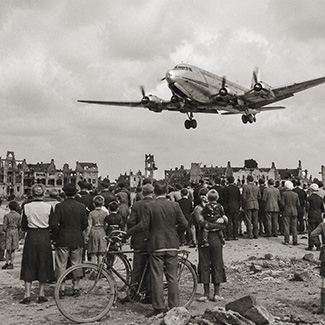
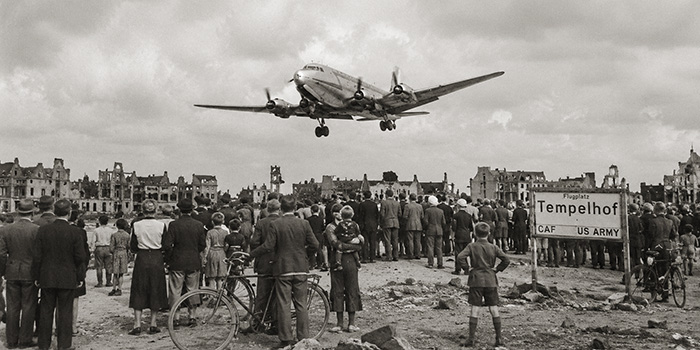
In 1948, the Western powers prepared, among other measures, a currency reform in their zones. Stalin responded by blocking land access to West Berlin in the hope of forcing the Western powers to abandon the city. The United States and its allies answered with a massive airlift that supplied the population with food, coal, and essential goods for nearly a year. The blockade was finally lifted in May 1949. A few months later, the Western zones became the Federal Republic of Germany, while the Soviet zone became the German Democratic Republic.
Two Military Blocs
The confrontation also became more structured militarily. In 1949, the United States, Canada, and several Western European countries created the North Atlantic Treaty Organization, NATO. Its central principle was collective defence: an attack on one member would be considered an attack on all.
When West Germany joined NATO, the Soviet Union responded in 1955 by creating the Warsaw Pact with several communist states of Eastern Europe. Two major military alliances now faced each other across the continent, each backed by a nuclear-armed superpower.
Communist China and the Expansion of the Conflict
The Cold War quickly spread beyond Europe. In China, the civil war resumed after Japan’s defeat and pitted Chiang Kai-shek’s Nationalists against Mao Zedong’s Communists. In 1949, Mao won and proclaimed the People’s Republic of China, while the Nationalists retreated to Taiwan.
This victory profoundly changed the global balance of power. The world’s most populous country was now part of the communist camp, even though relations between Beijing and Moscow would deteriorate sharply beginning in the 1960s. The Cold War was therefore never simply a confrontation between two states: it gradually involved a multitude of countries, alliances, and revolutionary movements.
The Korean War
Korea became the first major military battlefield of the Cold War. After Japan’s surrender in 1945, the peninsula was divided around the 38th parallel. A communist regime led by Kim Il-sung was established in the North, while an anti-communist government supported by the United States controlled the South.
In June 1950, North Korea invaded the South. The United States intervened at the head of a force operating under a United Nations mandate and pushed North Korean troops back almost to the Chinese border. Mao’s China then intervened massively, reversing the situation once again. The fighting eventually stabilized near the original dividing line. The 1953 armistice ended the combat without producing a true peace treaty, leaving the peninsula divided between two rival regimes.
The Nuclear Balance of Terror
Nuclear weapons quickly became the core of the confrontation. The United States held an atomic monopoly after Hiroshima and Nagasaki, but the Soviet Union tested its first bomb in 1949. Both powers then developed thermonuclear weapons far more destructive than the original atomic bombs, as well as missiles capable of travelling thousands of kilometres.
By the 1960s, both the United States and the USSR possessed enough weapons to destroy the other even after absorbing a first strike. This retaliatory capability gave rise to the logic of mutually assured destruction. Paradoxically, the enormous destructive power of the arsenals helped prevent direct war: no leader could reasonably expect to win a full-scale nuclear confrontation. Peace between the superpowers therefore rested in part on the certainty of mutual catastrophe.
Khrushchev and the Limits of De-Stalinization
Stalin’s death in 1953 opened a new period. Nikita Khrushchev gradually emerged as the leader of the USSR and in 1956 denounced several crimes committed under his predecessor. This process of de-Stalinization suggested a degree of openness, but it did not call Soviet domination of Eastern Europe into question.
That same year, an uprising broke out in Hungary. Demonstrators demanded reforms and greater independence from Moscow. Soviet troops intervened brutally and crushed the movement. The episode revealed a fundamental limit of the Soviet system: internal reforms might be tolerated, but the USSR would not allow a country in its bloc to leave its strategic orbit.
Sputnik and the Space Race
The rivalry between the superpowers extended to science and technology. In 1957, the Soviet Union placed Sputnik 1 into orbit, becoming the first nation to launch an artificial satellite. Four years later, Yuri Gagarin became the first human being to travel into space. These achievements caused a shock in the United States, where Soviet advances in rocketry were feared to imply a military advantage as well.
President John F. Kennedy then set the spectacular goal of landing an American on the Moon before the end of the 1960s. The objective was achieved in July 1969 when Neil Armstrong and Buzz Aldrin walked on the lunar surface during Apollo 11. The space race thus became a public demonstration of scientific, industrial, and ideological power.
The Berlin Wall
Berlin remained an especially visible symbol of Europe’s division throughout this period. Between 1949 and 1961, millions of East Germans left for the West, many of them passing through Berlin. This exodus deprived East Germany of many skilled workers and seriously weakened the regime.
During the night of August 12–13, 1961, East German authorities closed the border between East and West Berlin. A temporary barrier was soon replaced by a system of walls, fences, guard towers, and restricted zones. Families were separated overnight, and several people died while attempting to cross. The Berlin Wall became one of the most powerful symbols of the Cold War.
Cuba on the Brink of Nuclear War
The Cuban Revolution of 1959 brought Fidel Castro to power only a short distance from the American coast. Relations between Washington and Havana deteriorated rapidly as Cuba moved closer to the Soviet Union. In 1961, an invasion attempt by Cuban exiles supported by the United States failed at the Bay of Pigs, strengthening the alliance between Castro and Moscow.
The following year, American aircraft discovered that the USSR was installing nuclear missiles in Cuba capable of reaching much of the United States. Kennedy imposed a naval quarantine around the island and demanded their removal. For thirteen days in October 1962, the world appeared closer than ever to nuclear war. Khrushchev eventually agreed to remove the missiles in exchange for an American commitment not to invade Cuba; the United States also quietly removed some of its missiles stationed in Turkey. The crisis showed how quickly a poorly controlled confrontation could lead to global catastrophe.
Vietnam, the Emblematic War
Vietnam then became the most significant conflict associated with American efforts to contain communism. After the end of French colonial rule, the country was divided between a communist North led by Ho Chi Minh and a South supported by Washington. American leaders feared that a communist victory in Vietnam would cause other Asian countries to fall into the same camp according to the “domino theory.”
American intervention expanded dramatically during the 1960s, with several hundred thousand troops deployed. Despite their technological superiority, the United States failed to destroy the North Vietnamese forces and their Viet Cong allies. The war caused enormous civilian and military losses and generated growing opposition within American society itself. After the gradual withdrawal of U.S. forces, Saigon fell in 1975 and the country was reunified under communist rule. For Washington, Vietnam became a symbol of the limits of American power.
Prague and Soviet Domination in Eastern Europe
In 1968, Czechoslovak leader Alexander Dubček attempted to create “socialism with a human face” by relaxing censorship and introducing certain political freedoms. These reforms, known as the Prague Spring, quickly alarmed Moscow, which feared that too much change could undermine the cohesion of the Soviet bloc.
In August, Warsaw Pact forces invaded Czechoslovakia and ended the experiment. The intervention gave rise to what became known as the Brezhnev Doctrine: the USSR reserved the right to intervene in a socialist country if it believed that communist rule there was under threat.
Détente
After the crises over Berlin, Cuba, and Vietnam, the two superpowers gradually sought to make their rivalry more predictable. The 1970s were marked by détente, a period during which Washington and Moscow tried to reduce certain risks without ending their opposition.
Agreements were reached on strategic weapons, while President Richard Nixon also initiated a spectacular rapprochement with Mao’s China in 1972. The Helsinki Accords of 1975 recognized the European borders established after the Second World War while also affirming certain principles concerning human rights. Détente reduced some direct tensions, but conflicts continued in many parts of the world.
Proxy Wars
One of the defining characteristics of the Cold War was precisely that the United States and the Soviet Union generally avoided fighting each other directly while supporting opposing sides elsewhere. Civil wars and local conflicts in Africa, Asia, the Middle East, and Latin America therefore acquired an international dimension.
In Angola, the USSR and Cuba supported the Marxist government, while the United States and South Africa backed some of its opponents. In Central America, Washington supported anti-communist governments or movements, while Cuba and sometimes Moscow assisted revolutionary groups. These conflicts demonstrated that the Cold War was global and that its deadliest consequences often fell on populations living far from Washington and Moscow.
Afghanistan and the Return of Tensions
In December 1979, the Soviet Union intervened militarily in Afghanistan to support a threatened communist government. The occupation met fierce resistance from Afghan fighters known as the mujahideen, who received weapons and assistance from the United States, Pakistan, Saudi Arabia, and others.
The conflict became long, costly, and demoralizing for the USSR. It also helped bring détente to an end. Relations between Washington and Moscow hardened once again, and the United States boycotted the 1980 Moscow Olympic Games. Four years later, the Soviet Union and several of its allies boycotted the Los Angeles Games in return.
Reagan and a New Confrontation
Ronald Reagan, elected president of the United States in 1980, adopted a much more aggressive policy toward the Soviet Union. He sharply increased military spending, supported anti-communist movements in several regions, and described the USSR as an “evil empire.” His administration also launched the Strategic Defense Initiative, an ambitious project intended to develop defences against nuclear missiles.
This new pressure came at a time when the Soviet economy was suffering from stagnation, low productivity, and the enormous burden of military spending. The Soviet Union remained a military superpower, but it found it increasingly difficult to sustain economic and technological competition with the United States.
Gorbachev Changes the Rules
Mikhail Gorbachev became Soviet leader in 1985 and understood that the system could not survive without major reforms. He launched perestroika, intended to restructure the economy, and glasnost, which encouraged greater transparency and a degree of freedom of expression. These reforms, however, released criticism and demands that the regime had long suppressed.
Internationally, Gorbachev sought to reduce confrontation with the West. His meetings with Ronald Reagan led in particular to the 1987 treaty on intermediate-range nuclear forces, which eliminated an entire category of missiles. Most importantly, he gradually abandoned the idea that the USSR had to intervene militarily to keep communist regimes in power across Eastern Europe.
1989 and the Fall of the Wall
The year 1989 transformed Eastern Europe. In Poland, the Solidarity movement won a major political victory in partially free elections. Hungary opened its border with Austria, allowing many East Germans to reach the West. Increasingly large demonstrations then shook East Germany.
On November 9, 1989, a confused announcement by the authorities about new travel regulations sent thousands of East Berliners toward the crossing points. Overwhelmed, the guards eventually opened the barriers. People crossed the wall and soon began tearing it down. The event immediately became the symbol of the collapse of the communist bloc in Europe. Less than a year later, Germany was reunified.
The Collapse of the Soviet Union
Communist regimes in Central and Eastern Europe fell one after another, while tensions increased within the USSR itself. Several Soviet republics demanded sovereignty, and economic reforms failed to resolve the country’s deepening problems.
In August 1991, conservative officials attempted a coup against Gorbachev in an effort to preserve the old system. Their failure instead accelerated its disintegration. Boris Yeltsin, president of Russia, became one of the leading political figures of the moment. In December, the Soviet Union officially ceased to exist and was replaced by fifteen independent states.
The disappearance of the USSR marked the end of the Cold War. For nearly half a century, this rivalry had structured global politics, divided Europe, fuelled wars on several continents, and placed humanity under the permanent threat of nuclear destruction. It also shaped science, culture, sport, propaganda, and espionage to such an extent that it remains one of the essential frameworks for understanding the history of the second half of the twentieth century.
Quiz questions preview
-
Which important treaty between the USA and the USSR was first negotiated in 1969?
SALT I | INF | PTBT | START II -
With which country has the USSR resumed dialogue in 1984 after a fifteen-year break due to conflict?
China | Germany | La France | The United States -
Which nation launched the first artificial satellite, extending the Cold War into space for the first time?
The Soviet Union | China | The United States | France -
In which incident did the USSR shoot down a DC-3 plane on June 13, 1952, then a seaplane sent to assist over the Baltic Sea?
U-2 affair | Powers incident | North Crisis | Catalina affair -
On which date were East Germany and West Germany reunified?
November 3, 1990 | June 12, 1988 | July 2, 1992 | October 3, 1991

