
A Stay in Venice — Topic Guide
Venice is a city where water replaces major avenues. Its palaces, churches, and houses are reflected in the canals, while travel is done on foot or by boat. A stay offers the chance to explore an exceptional heritage, along with residential neighbourhoods, markets, and cuisine shaped by the lagoon.
A City Built on Water
Venice extends across a group of islands connected by bridges and separated by canals. Founded in the lagoon, it became a major maritime and commercial power during the Middle Ages. This history explains the richness of its palaces, churches, and art collections.
The Grand Canal crosses the city in a broad curve. Travelling along it by vaporetto provides views of Gothic, Renaissance, and Baroque façades that were originally designed to be admired from the water.
St. Mark’s Square
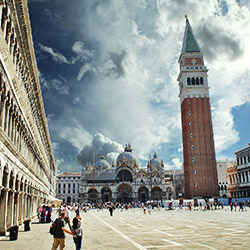
St. Mark’s Square forms the monumental heart of Venice. The basilica is distinguished by its domes, golden mosaics, and Byzantine influences, which recall the city’s historic ties with the East.
Nearby, the Doge’s Palace was the seat of government of the Venetian Republic and the residence of the doge. Its rooms, courtyards, and passageways reveal the former power of Venice.
The Bridge of Sighs connects the palace with the old prisons. The campanile, meanwhile, offers broad views over the rooftops, domes, and islands of the lagoon.
Rialto and the Grand Canal
The Rialto Bridge is one of the most famous crossings over the Grand Canal. The surrounding area also recalls the commercial importance of Venice.
Nearby, the Rialto Market remains associated with fish, fruit, and vegetables. It provides a glimpse of a more everyday side of the city.
The palaces lining the canal reflect the wealth of Venice’s former merchant families. Ca’ d’Oro, with its Gothic façade, is among the best known.
The Six Historic Districts
Venice is divided into six sestieri: San Marco, San Polo, Santa Croce, Cannaregio, Castello, and Dorsoduro. Each has a distinct atmosphere.
San Marco contains the most famous monuments. San Polo is centred around Rialto, while Santa Croce forms one of the main land entrances to the city.
Cannaregio offers quieter streets, residential canals, and the historic Jewish Ghetto. Castello, the largest district, includes working-class areas, gardens, and the former Arsenal.
Dorsoduro has an important artistic and university presence. Its waterfronts provide pleasant walks, while the Accademia Bridge offers a remarkable view of the Grand Canal.
Art, Churches, and Museums
The Gallerie dell’Accademia displays an important collection of Venetian painting, including works by Bellini, Titian, Tintoretto, and Veronese.
The Peggy Guggenheim Collection, housed in a palace on the Grand Canal, is devoted to modern art. Punta della Dogana also presents contemporary exhibitions.
The church of Santa Maria della Salute dominates the entrance to the Grand Canal with its large dome. The Basilica of Santa Maria Gloriosa dei Frari contains major artworks and tombs, while San Giorgio Maggiore offers a beautiful view across St. Mark’s Basin.
Murano, Burano, and Torcello
The lagoon extends far beyond the historic centre. Murano is famous for glassmaking and its workshops. Burano is recognized by its brightly coloured houses and remains associated with lace-making and fishing.
Torcello, which is far less populated, recalls the earliest settlements in the lagoon. Its cathedral and open spaces create an atmosphere very different from that of central Venice.
It is best not to try to visit too many islands in a single day. The journeys take time, but they are an essential part of the experience.
Gondolas, Vaporetti, and Walking
The gondola remains one of the great symbols of Venice. A ride allows visitors to travel through narrow canals and view buildings from the water. It is, however, mainly a tourist experience rather than an everyday means of transportation.
Vaporetti form the city’s public boat network. They connect neighbourhoods, railway stations, and several islands. A journey along the Grand Canal is itself a panoramic tour.
Walking remains essential. Venice reveals itself through its calli, small bridges, passageways, and campi. Unexpected detours often lead to courtyards, churches, and quieter waterfronts.
Venetian Flavours
Cicchetti are small portions served in bàcari, Venice’s traditional bars. They may include fish, vegetables, eggs, cheese, or various toppings served on bread.
Baccalà mantecato is a creamy preparation of salt cod served with bread or polenta. Sarde in saor combines sardines, onions, vinegar, raisins, and pine nuts. Risottos, seafood, and dishes made with squid ink reflect the city’s close relationship with the lagoon.
Trying a few cicchetti in several establishments is a good way to discover different flavours. More residential neighbourhoods often provide a culinary experience distinct from that of the busiest tourist areas.
Planning a Stay
The main monuments are best grouped by area. St. Mark’s Square and the Doge’s Palace can occupy half a day or more. Rialto combines easily with San Polo, while Dorsoduro deserves a separate itinerary.
Venice sometimes experiences episodes of acqua alta, during which certain low-lying areas are temporarily flooded. Heavy tourism also affects movement through the city. A flexible itinerary that alternates famous sites with quieter neighbourhoods makes it easier to appreciate Venice without reducing the stay to a succession of attractions.
Quiz questions preview
-
Where are the Doge's Palace, St. Mark's Campanile and St. Mark's Basilica?
St. Mark's Square | Rialto Square | Campo Santa Margherita | Campo San Polo -
What event is held every first Sunday in September?
The Venice Biennale | The historical Regatta of Venice | The Venice Marathon | The Carnival of Venice -
How do you name a pedestrian way along a canal in Venice?
Campo | Pavimento | Marciapiede | Fondamenta -
This event, which takes place on Pentecost Sunday, brings together thousands of boats every year.
Mostra | Sensa | Vogalonga | Regata Storica -
Where is Venice located in Italy?
In the North West of Italy | In the North East of Italy | In central Italy | In central-western Italy

