A Stay in Quebec — Topic Guide
An immense territory crossed by the St. Lawrence River, Quebec brings together historic cities, forests, lakes, mountains and villages shaped by the rhythm of the seasons. Its identity rests on the French language, a distinctive North American heritage, living traditions and a natural environment that remains central to the visitor experience.
Montreal, a Cultural Metropolis
Montreal is Quebec’s main gateway and its most cosmopolitan city. Its downtown core includes skyscrapers, museums, performance halls and major shopping streets, while Old Montreal preserves cobblestone streets, stone buildings and historic squares. Notre-Dame Basilica, the Old Port and Bonsecours Market are among its best-known landmarks.
Mount Royal overlooks the city and offers trails, lookouts and large green spaces. The Plateau-Mont-Royal is known for its outdoor staircases, colourful houses, cafés and shops. Mile End, Little Italy, the Latin Quarter and the Village also reflect the city’s cultural diversity.
Montreal is a city of festivals devoted to jazz, comedy, cinema and digital arts, among other fields. In summer, its streets and terraces come alive, while in winter, the underground network makes it easier to travel through the downtown area.
Quebec City, a Historic Capital
Quebec City has a very different character. Founded in the early 17th century, it preserves an exceptional fortified district that is unique in North America. Old Quebec is divided between the Upper Town, dominated by the Château Frontenac and Dufferin Terrace, and the Lower Town, where Place Royale and the Petit-Champlain district are located.
The city walls and the Citadelle recall Quebec City’s military importance. The Plains of Abraham are now a large urban park, but they were also the site of a decisive battle between French and British forces in 1759.
Nearby, Montmorency Falls are higher than Niagara Falls. Île d’Orléans offers villages, farmland, orchards and regional products. The Côte-de-Beaupré leads toward the Sainte-Anne-de-Beaupré Basilica and the first mountain landscapes of Charlevoix.
The St. Lawrence River
The St. Lawrence shapes much of Quebec’s inhabited territory. It connects the Great Lakes to the Atlantic Ocean and long served as the main route for transportation, trade and settlement. Its shores range from agricultural plains to cliffs, islands and wide estuaries.
Several regions can be explored by following the river:
-
Mauricie is known for its forests, lakes and La Mauricie National Park.
-
Charlevoix combines mountains, villages, scenic roads and views of the St. Lawrence.
-
Bas-Saint-Laurent is marked by sunsets, lighthouses, islands and riverside towns.
-
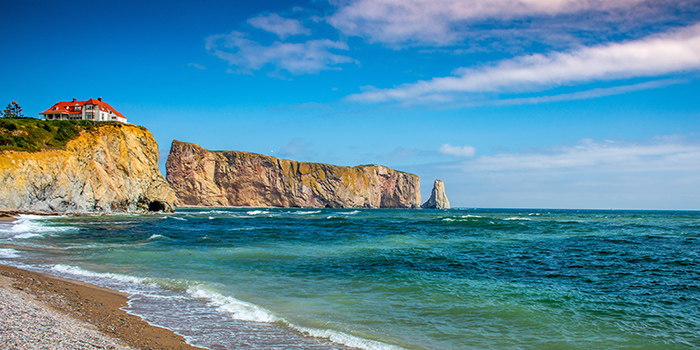
Gaspésie is distinguished by its cliffs, headlands, fishing villages and Percé Rock.
-
Côte-Nord extends along a vast shoreline dotted with bays, rivers and wild landscapes.
Several whale species can be observed in the estuary and the Gulf of St. Lawrence. Tadoussac is one of the main departure points for boat excursions, although whales can also be seen from certain coastal areas.
Great Outdoors and Parks
Nature is one of Quebec’s greatest attractions. The provincial and national park network protects mountains, forests, lakes, rivers and northern environments. Hiking, canoeing, kayaking, camping and wildlife observation play a central role.
Jacques-Cartier National Park is known for its deep glacial valley, while Hautes-Gorges-de-la-Rivière-Malbaie National Park features high cliffs. Gaspésie National Park provides access to the Chic-Choc Mountains, where caribou can still be found.
Farther north, the landscapes become wider and less inhabited. Nunavik, located north of the 55th parallel, belongs to the Arctic world. It is characterized by tundra, permafrost, long summer days and extended winter nights. These territories require considerable preparation and are generally accessible by air.
The Regions and Their Distinctive Characters
Each region has its own identity, shaped by its landscape, history and traditional activities.
-
The Laurentians are known for their lakes, mountains, ski resorts and vacation destinations.
-
Lanaudière offers rural roads, forests, outfitter camps and many outdoor activities.
-
The Eastern Townships combine villages, hills, vineyards, lakes and Anglo-American-inspired architecture.
-
Centre-du-Québec is marked by agriculture, sugar bushes and the wetlands of Lake Saint-Pierre.
-
Saguenay–Lac-Saint-Jean is distinguished by its fjord, enormous lake, blueberry fields and strong regional identity.
-
Abitibi-Témiscamingue features large lakes, forests and a heritage connected to mining.
-
Outaouais includes Gatineau, the Ottawa River and Gatineau Park.
The Magdalen Islands occupy a special place. Located in the Gulf of St. Lawrence, they are known for red cliffs, dunes, beaches, colourful houses and a strong maritime culture.
Quebec Through the Seasons
The seasons profoundly transform Quebec’s landscapes and activities. Summer is ideal for festivals, hiking, water excursions, camping and long evenings outdoors. Temperatures can be hot and humid in the south, but remain cooler near the Gulf of St. Lawrence.
Autumn is associated with the changing colours of the forests, especially in the Laurentians, Charlevoix, the Eastern Townships and Mauricie. This short season is well suited to scenic drives and hiking.
Winter occupies a major place in Quebec culture. Alpine skiing, cross-country skiing, snowshoeing, skating, snowmobiling and ice fishing are practised in many regions. The Quebec Winter Carnival is especially known for its parades, snow sculptures and its mascot, Bonhomme Carnaval.
Spring corresponds with the melting snow and maple sugar season. Sugar shacks serve traditional meals accompanied by maple syrup, often in a festive and family-oriented atmosphere.
Culture, Language and Heritage
French is Quebec’s official language and remains central to its identity. Accents and expressions vary from one region to another. English is also commonly spoken in Montreal and in many tourist areas.
Quebec culture is expressed through music, theatre, cinema, literature, comedy and the visual arts. Religious traditions have left behind many churches, chapels and works of art, even though society has become largely secular.
First Nations and Inuit peoples hold an essential place in the history and contemporary reality of the territory. Museums, cultural centres and tourism experiences provide opportunities to learn more about their languages, knowledge, arts and relationship with the land. Initiatives led directly by the communities themselves should be preferred.
Quebec Flavours
Quebec cuisine draws on French, British, Indigenous and North American traditions. Tourtière, shepherd’s pie, pea soup, baked beans and slow-cooked dishes are part of its culinary heritage. Poutine, made with French fries, cheese curds and brown gravy, has become one of Quebec’s most popular symbols.
Maple syrup is used in desserts, sauces, marinades and various artisanal products. Cheese, cider, craft beer, berries and seafood also occupy an important place. In eastern Quebec, lobster, snow crab, northern shrimp and fish from the St. Lawrence are particularly prized.
Montreal is known for its bagels, smoked meat and multicultural cuisine. Quebec City and the regions place greater emphasis on local products, public markets, inns and farm-to-table restaurants.
Transportation and Trip Planning
Distances are considerable. Montreal and Quebec City are well connected by road, bus, train and air, but many regions are easier to explore by car. Journeys can be long, especially in Gaspésie, along the Côte-Nord or toward the northern territories.
Weather conditions must always be taken seriously. In winter, appropriate tires, warm clothing and additional travel time are essential. In summer, protection against mosquitoes and other insects is recommended in wooded areas.
For a first visit, combining Montreal, Quebec City and one natural region provides a good introduction to the territory’s main contrasts. A longer journey can follow the St. Lawrence, reach the Saguenay, explore Gaspésie or venture into the vast landscapes of the north.
Quiz questions preview
-
How many tourists traveled to Quebec in 2018?
40 million | 25 million | 30 million | 35 million -
During which season does lobster fishing, vital to the economy of the Magdalen Islands, take place?
Fall | Summer | Spring | Winter -
This national park located in the middle of the Ungava Plateau is the most northerly in Quebec.
Ulittaniujalik National Park | Pingualuit National Park | Tursujuq National Park | Kuururjuaq National Park -
Where does the most famous western festival in Quebec take place?
Saint-Tite | Sainte-Anne-de-la-Pérade | Saint-Hyacinthe | Louiseville -
Which highway connects the cities of Montreal and Sherbrooke?
Autoroute 15 | Autoroute 20 | Autoroute 13 | Autoroute 10

