Swinging Sixties — Topic Guide
The “Swinging Sixties” refers to the cultural excitement that transformed the United Kingdom, especially London, during the mid-1960s. A new generation challenged the conventions inherited from the postwar era. Music, fashion, cinema, photography, and new freedoms created the image of a young, inventive society looking toward the future.
London at the Centre of the Movement
After the years of austerity that followed the Second World War, prosperity gradually returned to the United Kingdom. Young people had more money, independence, and leisure time. They became an important audience for record companies, clothing shops, magazines, and clubs.
London concentrated much of this energy. The districts of Soho, Chelsea, and Carnaby Street attracted artists, musicians, models, photographers, and designers. The city projected a modern image that contrasted sharply with the rigidity often associated with traditional British society.
The expression “Swinging London” popularized the idea of a capital in constant motion, dominated by youth and novelty. This image was incomplete, however: social inequalities remained, and not everyone took part in the cultural revolution.
The Explosion of British Music
Music was the most visible driving force of the Swinging Sixties. The Beatles achieved international success and helped transform popular music. Their evolution, from catchy early songs to more experimental albums, reflected the growing ambitions of rock music.
The Rolling Stones cultivated a more rebellious image influenced by American blues. The Who expressed the frustration and energy of urban youth, while the Kinks observed British life with irony.
Other artists contributed to the “British Invasion” that conquered the American charts. Dusty Springfield, Petula Clark, Donovan, and the Animals were among the important names of the period.
Recording studios also became places of experimentation. Musicians used new effects, added a wider range of instruments, and designed albums as coherent works. Psychedelic rock developed through bands such as Pink Floyd, Cream, and Traffic.
Fashion and Appearance
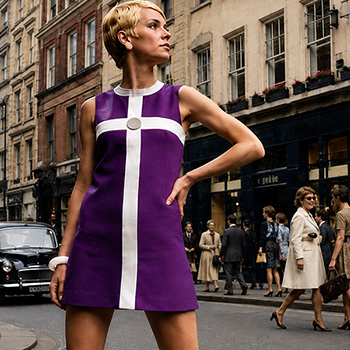
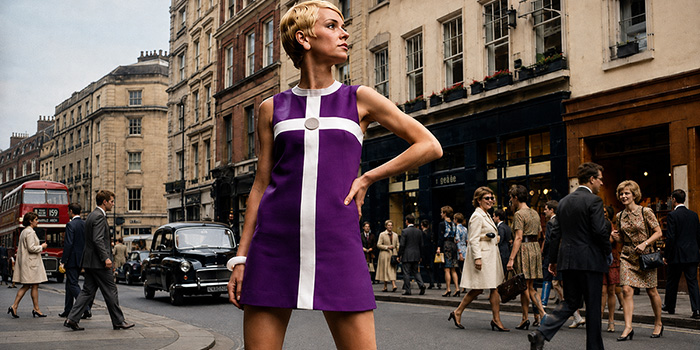
The fashion of the Swinging Sixties broke with the stricter elegance of previous decades. Clothes became shorter, more colourful, and more geometric.
Mary Quant was closely associated with the popularization of the miniskirt. Her designs represented fashion that was youthful, practical, and accessible. Carnaby Street became famous for its shops aimed at young men, selling colourful shirts and fitted jackets.
Models Twiggy and Jean Shrimpton embodied a different standard of beauty. Their slim figures, dramatic makeup, and modern hairstyles were widely reproduced in magazines.
Fashion was no longer dictated only by major design houses. The street, musical groups, and youth subcultures now influenced designers.
Mods, Rockers, and Youth Culture
Young people developed their own styles and identities. Mods favoured tailored clothing, Italian scooters, American soul, and rhythm and blues. Rockers preferred motorcycles, leather jackets, and 1950s rock and roll.
Clashes between mods and rockers in several seaside towns were exaggerated by the press. They mainly revealed the anxiety felt by part of society toward a more independent younger generation.
Clubs, cafés, music programs, and pirate radio stations played an important role. These stations broadcast popular music from ships anchored offshore, avoiding British broadcasting restrictions.
Cinema, Photography, and the Visual Arts
British cinema adopted a freer and more critical tone. Films portrayed youth culture, working-class life, changing sexual attitudes, and the absurdity of older conventions.
Actors such as Michael Caine, Julie Christie, and Terence Stamp became symbols of the new era. James Bond, first played by Sean Connery, combined British elegance, technology, adventure, and sexual freedom.
Fashion photography strongly shaped the image of London. David Bailey photographed models and celebrities in a direct, modern, and less formal style.
Pop art drew inspiration from advertising, consumer goods, and popular culture. Artists such as Peter Blake brought art, music, and everyday life closer together.
Changing Social Attitudes
The Swinging Sixties accompanied a broader questioning of sexual and family conventions. The growing availability of the contraceptive pill gave many women greater control over their reproductive lives.
Censorship weakened, and the media discussed sexuality more openly. The British Parliament also adopted reforms concerning homosexuality, abortion, and divorce.
These changes did not eliminate gender inequality. Women were still often paid less and remained underrepresented in positions of power. The freedom displayed in magazines did not always reflect everyday reality.
A Society in Transformation
The decade was marked by debates over the Vietnam War, nuclear disarmament, civil rights, and immigration. Demonstrations gave a political dimension to youth culture.
The arrival of people from the Caribbean, South Asia, and other regions also transformed British society. This diversity enriched music, food, and urban life, but also provoked tension and racist reactions.
By the end of the 1960s, optimism had begun to fade. Economic difficulties, social conflict, and a darker culture gradually replaced the carefree spirit associated with “Swinging London.” The period nevertheless remains remembered as a time when the United Kingdom set the tone for global popular culture.
Quiz questions preview
-
He caused hysteria among his fans with his sex appeal and his warm, powerful voice.
Paul Anka | David Gilmour | Tom Jones | Neil Diamond -
Who performed the song from the opening credits of the film "You Only Live Twice" in 1967?
Shirley Bassey | Dusty Springfield | Nancy Sinatra | Petula Clark -
Who sang "Paint It Black" in 1966?
Deep Purple | The Yardbirds | The Rolling Stones | Cream -
Who sang "Time Of The Season" in 1968?
Chicago | Frank Zappa | The Zombies | America -
What major event was presented in England in 1966 at the height of the Swinging Sixties?
The Isle of Wight Festival | The Olympic Games | The FIFA World Cup | The World's Fair

