Expo 67 — Topic Guide
Expo 67 was one of the most significant events in the history of Montreal and Canada. For six months, the world’s fair transformed islands in the St. Lawrence River into an international showcase. Its architecture, innovations, and openness to the world embodied the optimism of an era convinced that progress could improve the future.
An Exhibition for Canada’s Centennial
Expo 67 was organized as part of the celebrations marking the centennial of Canadian Confederation. Montreal obtained the project after Moscow, which was initially expected to host the 1967 world’s fair, withdrew.
Mayor Jean Drapeau played a central role in bringing the event to life. Despite concerns about deadlines, costs, and the location, construction progressed quickly. The exhibition opened on April 27, 1967, and continued until October 29.
Tens of millions of visitors passed through its gates. Montreal became a meeting place for governments, businesses, artists, and cultures from around the world.
The Creation of New Land
The main site was developed on Île Sainte-Hélène and Île Notre-Dame, an artificial island created in the St. Lawrence River. Millions of tonnes of earth and rock were used to expand the available land. Some of the material came from the construction of the Montreal Metro.
This transformation of the landscape was already an impressive engineering achievement. It made it possible to build pavilions, gardens, public squares, and transportation networks in an area devoted entirely to the exhibition.
The Metro, inaugurated only a few months earlier, made the site easier to reach. Visitors could then travel by Expo-Express, Minirail, bus, or boat.
“Man and His World”
The official theme, “Man and His World,” was inspired by the English title of a book by Antoine de Saint-Exupéry. It expressed the idea that humanity should better understand its environment, share knowledge, and use progress for the benefit of society.
The exhibitions explored humanity, the environment, work, creativity, and relationships with others. The pavilions therefore did more than present the achievements of individual countries. They also offered visions of the future.
This approach reflected the spirit of the 1960s. Space exploration, nuclear energy, and new forms of communication encouraged great optimism about technology.
Pavilions from Around the World
Dozens of countries participated in the exhibition. Each pavilion sought to present its culture, history, achievements, and ambitions.
The Canadian pavilion occupied a central place. Its main structure, known as Katimavik, was shaped like an inverted pyramid.
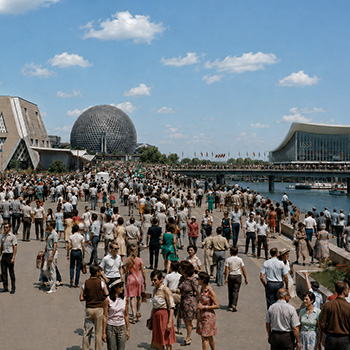
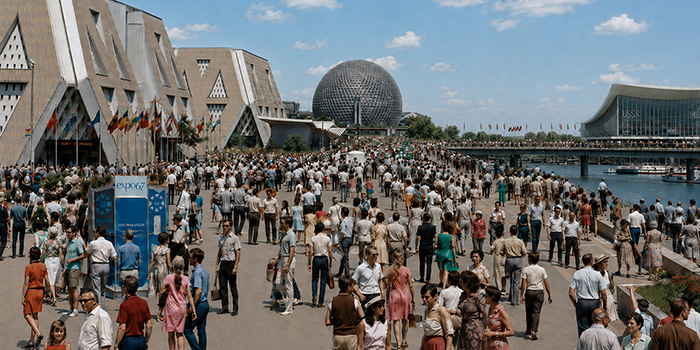
The United States pavilion stood beneath an enormous geodesic dome designed by Buckminster Fuller. Its transparent structure became one of the best-known images of Expo 67. The Soviet Union pavilion also attracted enormous crowds. At the height of the Cold War, the two superpowers used the exhibition to display their scientific achievements and visions of the future.
The other pavilions introduced visitors to cultures that were still relatively unfamiliar to many Canadians.
Experimental Architecture
Architecture was one of Expo 67’s greatest strengths. Designers used the occasion to experiment with unusual forms, materials, and construction methods.
The pavilions were often designed as complete experiences. Their exterior appearance, interior route, lighting, music, and projections formed a unified presentation intended to impress visitors.
Habitat 67, designed by Moshe Safdie, became one of the most remarkable projects. This residential complex of prefabricated concrete blocks sought to combine the density of urban apartment buildings with some of the advantages of private homes, including terraces and natural light.
Many buildings were demolished after the exhibition. Others survived and became permanent symbols of Montreal.
Innovation and Entertainment
Expo 67 presented many new developments in image, sound, transportation, and communication. Visitors discovered multiscreen projections, panoramic films, automated installations, and immersive experiences.
Film played an important role. Some theatres surrounded audiences with images and sound, anticipating several modern forms of multimedia presentation.
The exhibition also offered concerts, performances, and parades. La Ronde was the main area devoted to rides and family attractions. It continued operating after Expo 67 closed.
An Opening to the World
For many Quebecers and Canadians, Expo 67 was a first opportunity to experience distant cultures directly. At a time when international travel was less accessible, visitors could symbolically travel around the world in a single day.
Restaurants served foreign dishes, pavilions introduced unfamiliar languages and traditions, and performances featured music from several continents.
This openness reflected the changes taking place in Quebec. Montreal was modernizing rapidly, while the Quiet Revolution was transforming institutions and Quebec society’s place in the world.
Memorable Moments
Expo 67 welcomed many international figures. The most famous visit remains that of French president Charles de Gaulle.
On July 24, 1967, he delivered his famous “Vive le Québec libre!” declaration from the balcony of Montreal City Hall. The statement caused a diplomatic crisis with the Canadian government and left a lasting mark on Quebec’s political history.
Queen Elizabeth II, U.S. president Lyndon B. Johnson, and several other leaders also visited the exhibition.
A Lasting Legacy
After the official closing, several pavilions continued to welcome visitors under the name “Man and His World.” Interest gradually declined, however, and many buildings were abandoned or demolished.
The American dome later became the Biosphere, while the French pavilion now houses the Casino de Montréal. Habitat 67 still retains its residential function.
Expo 67 gave Montreal a reputation as a modern, ambitious, and internationally minded city. It left behind infrastructure, architectural landmarks, and a particularly strong collective memory. For those who visited it, the exhibition remains associated with a time when the future seemed filled with possibilities.
Quiz questions preview
-
Which of these countries had a pavilion on St. Helen's Island?
India | China | Israel | France -
Which airline had a pavilion?
Air Canada | Lufthansa | Pan Am | Air France -
This glass pavilion represented the forest with its many peaks, some as high as eight stories.
The Ecology Pavilion | The Boreal Forest Pavilion | The Biosphere Pavilion | The Pulp and Paper Industry Pavilion -
This pavilion was wisely located between the France and Ontario pavilions.
The United States pavilion | The Maritimes pavilion | The United Kingdom pavilion | The Quebec pavilion -
How many versions of passports were available?
2 | 4 | 6 | 5

