
The Quest for the Moon — Topic Guide
In 1957, the launch of Sputnik by the Soviet Union transformed space into a new arena of rivalry between the two great powers of the Cold War. For fifteen years, the United States and the USSR multiplied satellites, probes, crewed flights, and technological achievements in order to demonstrate the superiority of their political and scientific systems. This race culminated in July 1969 with the first steps of Neil Armstrong and Buzz Aldrin on the Moon, then continued until Apollo 17, the last human visit to the lunar surface in December 1972.
The Cold War Reaches Space
-
After the Second World War, the United States and the Soviet Union became the world’s two leading powers.
-
Their political, military, scientific, and ideological rivalry became known as the Cold War.
-
Both countries developed missiles capable of carrying nuclear weapons over very long distances.
-
The rockets used to launch satellites and space capsules were largely derived from this military research.
-
Space exploration became a means of demonstrating a country’s technological, industrial, and educational power.
-
Every success was widely used for propaganda, while failures were often concealed.
-
The Moon gradually became the most spectacular objective of this competition.
The Legacy of German Rockets
-
During the Second World War, Nazi Germany developed the V2 rocket, the first ballistic weapon to reach the edge of space.
-
The program was led by engineer Wernher von Braun.
-
Thousands of prisoners subjected to forced labor died during the production of the V2 rockets.
-
After the war, the United States and the Soviet Union recovered rockets, documents, and German specialists.
-
Von Braun and several members of his team were transferred to the United States through Operation Paperclip.
-
They later participated in the development of American missiles and the rockets used in the Apollo program.
-
Soviet engineer Sergei Korolev led much of the USSR’s space program.
-
His identity remained secret until after his death in 1966.
Sputnik, the First Artificial Satellite
-
On October 4, 1957, the Soviet Union launched Sputnik 1, the first artificial satellite placed in orbit around Earth.
-
Sputnik was a metal sphere equipped with four antennas.
-
Its radio signal could be received by observers in several countries.
-
The satellite carried no complex scientific instruments, but its political importance was immense.
-
The United States discovered that the USSR possessed a rocket powerful enough to place an object in orbit.
-
This capability also meant that the Soviets could potentially launch long-range missiles.
-
The “Sputnik shock” led the United States to reexamine science education, research, and national defense.
Laika and the First Living Creatures
-
On November 3, 1957, the Soviet Union launched Sputnik 2 with the dog Laika aboard.
-
Laika became the first animal placed in orbit around Earth.
-
The capsule had no system for returning her alive.
-
Soviet authorities initially claimed that she had survived for several days.
-
It was revealed much later that she had probably died only a few hours after launch from heat and stress.
-
Other animals were later sent into space to study the effects of weightlessness and acceleration.
-
In 1960, the Soviet dogs Belka and Strelka returned alive after an orbital flight.
-
These experiments prepared the way for human spaceflight while also raising major ethical questions.
The Difficult American Beginnings
-
The first American attempt to launch a satellite, Vanguard TV3, failed publicly in December 1957.
-
The rocket rose only slightly before exploding on the launchpad.
-
Images of the failure reinforced the impression that the Soviet Union was far ahead.
-
On January 31, 1958, the United States finally succeeded in placing Explorer 1 into orbit.
-
The satellite’s instruments led to the discovery of radiation belts surrounding Earth.
-
These regions were named the Van Allen belts after scientist James Van Allen.
-
Explorer 1 demonstrated that space missions could produce major scientific discoveries.
The Creation of NASA
-
In 1958, the United States government created the National Aeronautics and Space Administration, better known as NASA.
-
The new agency brought together several civilian aeronautics and space research programs.
-
Its goal was to coordinate American efforts and catch up with the Soviet lead.
-
NASA developed centers specializing in rockets, crewed spaceflight, communications, and scientific research.
-
The launch center at Cape Canaveral, Florida, became one of the main sites of the American space program.
-
Mission control for crewed flights was later established near Houston, Texas.
-
Thousands of companies, universities, and laboratories contributed to the space effort.
The First Probes to the Moon
-
Before sending humans, both powers launched many robotic probes toward the Moon.
-
Several early American and Soviet attempts failed at launch or missed their target.
-
In 1959, the Soviet probe Luna 1 became the first human-made object to pass near the Moon.
-
That same year, Luna 2 became the first spacecraft to reach the lunar surface.
-
Luna 3 then photographed the far side of the Moon for the first time.
-
This side is never visible from Earth because the Moon always presents the same face to our planet.
-
In 1966, Luna 9 achieved the first soft landing and transmitted photographs from the surface.
-
The probes confirmed, among other things, that the lunar soil could support the weight of a spacecraft.
Yuri Gagarin, the First Human in Space
-
On April 12, 1961, Soviet cosmonaut Yuri Gagarin became the first human to travel into space.
-
His Vostok 1 capsule completed one full orbit around Earth.
-
The flight lasted approximately 108 minutes.
-
Gagarin had very little control over the capsule, which operated largely automatically.
-
During reentry, he ejected several kilometers above the ground and landed separately by parachute.
-
His achievement made him an international hero and greatly increased Soviet prestige.
-
The United States had once again been beaten to a major milestone in the space race.
Alan Shepard and Project Mercury
-
On May 5, 1961, Alan Shepard became the first American in space.
-
His Mercury-Redstone 3 flight did not, however, complete a full orbit.
-
The capsule made a suborbital flight lasting approximately fifteen minutes.
-
In February 1962, John Glenn became the first American to orbit Earth.
-
Project Mercury was intended to determine whether a human could survive and work in space.
-
The astronauts tested capsules, communication systems, spacesuits, and recovery procedures.
-
Mercury established the foundations for the Gemini and Apollo programs.
Kennedy Sets the Lunar Goal
-
American president John F. Kennedy was looking for a spectacular objective that would allow the United States to surpass the Soviet Union.
-
On May 25, 1961, he asked Congress to land a man on the Moon and return him safely to Earth before the end of the decade.
-
At that time, the United States had completed only one brief crewed spaceflight.
-
The objective was therefore extraordinarily ambitious.
-
Kennedy presented the conquest of the Moon as a demonstration of courage, science, and national power.
-
In a speech at Rice University in 1962, he declared that the United States chose to go to the Moon not because it was easy, but because it was hard.
-
Kennedy was assassinated in November 1963, nearly six years before the Apollo 11 landing.
Valentina Tereshkova
-
On June 16, 1963, Soviet cosmonaut Valentina Tereshkova became the first woman in space.
-
She completed 48 orbits around Earth aboard Vostok 6.
-
Tereshkova had been selected partly because of her parachuting experience.
-
Her flight represented another symbolic victory for the Soviet Union.
-
No other woman traveled into space for nearly twenty years.
-
The first American woman, Sally Ride, did not fly until 1983.
-
Despite Tereshkova’s achievement, women remained largely excluded from crewed space programs during the race to the Moon.
Project Gemini
-
Project Gemini, carried out from 1965 to 1966, served as a bridge between Mercury and Apollo.
-
Gemini capsules carried two astronauts.
-
The missions tested longer flights, spacewalks, and changes in orbit.
-
Astronauts learned how to bring two spacecraft together and dock them.
-
These maneuvers were essential for the future lunar journey.
-
In June 1965, Edward White performed the first American spacewalk.
-
Some spacewalks proved extremely exhausting, forcing NASA to improve movement techniques and equipment.
-
Gemini demonstrated that astronauts could live in space for nearly two weeks, long enough for a lunar mission.
The First Human in Open Space
-
On March 18, 1965, cosmonaut Alexei Leonov performed the first spacewalk.
-
He left the Voskhod 2 capsule through an inflatable airlock.
-
His spacesuit expanded in the vacuum, making it very difficult for him to return to the airlock.
-
Leonov had to reduce the pressure inside his suit, risking unconsciousness.
-
After returning to Earth, the capsule landed far from the planned area in an isolated forest.
-
Leonov and his colleague Pavel Belyayev had to wait for rescue in winter conditions.
-
The most dangerous details of the mission were concealed by Soviet authorities for many years.
Sergei Korolev and the Soviet Lunar Program
-
Sergei Korolev directed the great Soviet achievements, from Sputnik to the first crewed flights.
-
He also wanted to send cosmonauts around the Moon and later to its surface.
-
The Soviet program, however, suffered from rivalry between design bureaus and a lack of unified leadership.
-
Unlike the United States, the USSR did not immediately concentrate all of its resources on a single lunar project.
-
Korolev’s sudden death in January 1966 deprived the program of its principal organizer.
-
His successor, Vasily Mishin, did not possess the same political authority.
-
Technical difficulties accumulated while the United States advanced rapidly.
The Apollo Program
-
Apollo was designed to carry three astronauts to the Moon.
-
The command module served as the crew’s main living space and was designed to return to Earth.
-
The service module contained the main engine, electricity, and supplies.
-
The lunar module was intended to carry two astronauts to the surface and later return them to orbit.
-
The third crew member remained alone in the command module around the Moon.
-
After reuniting, the astronauts abandoned the lunar module and began the journey back to Earth.
-
This method, known as lunar-orbit rendezvous, was chosen because it required a less massive rocket than landing the entire spacecraft on the Moon.
The Saturn V Rocket
-
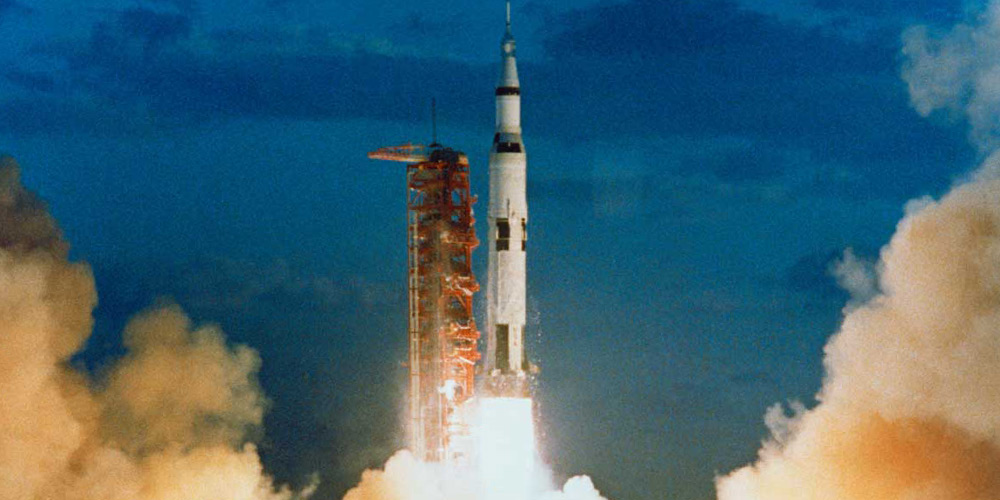
The Apollo program depended on the enormous Saturn V rocket.
-
It was developed under the direction of Wernher von Braun and his team at the Marshall Space Flight Center.
-
Approximately 111 meters tall, it had three main stages.
-
Its first stage burned an immense quantity of fuel in only a few minutes.
-
Saturn V remains one of the most powerful rockets ever used successfully.
-
It could place the Apollo spacecraft and lunar module on a trajectory toward the Moon.
-
Thirteen Saturn V rockets were launched, and none suffered a total failure.
-
Its development mobilized hundreds of thousands of workers and cost billions of dollars.
The People Behind Apollo
-
The Apollo program depended on far more than the astronauts alone.
-
Engineers, technicians, mathematicians, programmers, doctors, and factory workers all contributed to the missions.
-
Katherine Johnson, a NASA mathematician, calculated and verified trajectories used in several spaceflights.
-
Margaret Hamilton led the team responsible for the navigation software used in the command and lunar modules.
-
Apollo’s computers had extremely limited power by modern standards.
-
Their software nevertheless had to operate with exceptional reliability and manage several tasks at once.
-
Women and members of minority groups contributed to the program despite the discrimination present in American society.
The Apollo 1 Fire
-
On January 27, 1967, astronauts Virgil “Gus” Grissom, Edward White, and Roger Chaffee were taking part in a ground test.
-
A fire broke out inside the Apollo 1 cabin, which was filled with pure oxygen under pressure.
-
The fire spread extremely quickly.
-
The capsule door opened inward and could not be unlocked in time.
-
The three astronauts died within seconds.
-
The investigation revealed serious problems involving design, wiring, and program management.
-
NASA completely redesigned the capsule, hatch, materials, and safety procedures.
-
The disaster delayed crewed flights, but the corrections contributed to the success of later missions.
Soviet Disasters
-
The Soviet Union also experienced several serious accidents, many of which were kept secret.
-
In 1960, a missile explosion at Baikonur killed many engineers and military personnel in the Nedelin catastrophe.
-
Cosmonaut Valentin Bondarenko died in 1961 in a fire during training.
-
In April 1967, Vladimir Komarov died when the parachute of Soyuz 1 failed to deploy properly.
-
The Soyuz capsule had been launched despite several technical problems.
-
These accidents demonstrated that political pressure and overly ambitious schedules could endanger crews.
-
Families and the Soviet public often received only partial information.
Apollo 7 and the Return to Crewed Flight
-
In October 1968, Apollo 7 became the first crewed mission of the program after the Apollo 1 fire.
-
The astronauts tested the command module in Earth orbit for eleven days.
-
The mission verified the engines, communications, and life-support systems.
-
The crew, commanded by Walter Schirra, suffered from colds and had tense relations with mission control.
-
Despite these difficulties, the spacecraft functioned correctly.
-
The success of Apollo 7 allowed NASA to attempt a far more ambitious mission around the Moon.
Apollo 8 Around the Moon
-
In December 1968, Apollo 8 carried Frank Borman, James Lovell, and William Anders around the Moon.
-
They became the first humans to leave Earth orbit.
-
They also became the first to see the far side of the Moon directly.
-
On Christmas Eve, the crew read passages from Genesis during a television broadcast watched around the world.
-
William Anders took the photograph Earthrise, showing the colorful Earth rising above the lunar horizon.
-
This image helped present Earth as a fragile and isolated world in space.
-
Apollo 8 demonstrated that the command module could reach the Moon, enter orbit, and return safely to Earth.
Apollo 9 and the Lunar Module
-
In March 1969, Apollo 9 tested a crewed lunar module in space for the first time.
-
The mission remained in Earth orbit.
-
The astronauts separated the lunar module from the command module, then carried out a rendezvous and docking.
-
James McDivitt and Russell Schweickart tested the lunar module while David Scott remained in the command module.
-
Schweickart also performed a spacewalk using a suit designed for lunar operations.
-
The mission’s success confirmed that the lunar module could function independently.
Apollo 10, the Dress Rehearsal
-
In May 1969, Apollo 10 completed an almost full rehearsal for the first lunar landing.
-
Thomas Stafford and Eugene Cernan descended in the lunar module to approximately fifteen kilometers above the surface.
-
John Young remained in the command module in lunar orbit.
-
The lunar module was nicknamed Snoopy, while the command module was called Charlie Brown.
-
The mission tested communications, trajectories, and the procedures planned for Apollo 11.
-
It demonstrated that NASA was ready to attempt a crewed landing.
Apollo 11 and the First Lunar Landing
-
Apollo 11 launched on July 16, 1969, with Neil Armstrong, Buzz Aldrin, and Michael Collins.
-
The lunar module Eagle separated from the command module Columbia in orbit around the Moon.
-
Collins remained alone aboard Columbia while Armstrong and Aldrin descended toward the surface.
-
The onboard computer triggered several alarms during the descent, but mission control determined that the landing could continue.
-
Armstrong noticed that the planned landing area was covered with rocks and took manual control of the module.
-
Eagle landed in the Sea of Tranquility on July 20, 1969.
-
Only a small amount of fuel remained at the moment of landing.
The First Steps on the Moon
-
Neil Armstrong descended from the lunar module several hours after landing.
-
He became the first human to walk on another world.
-
He spoke a now-famous sentence about one small step for man and one giant leap for humankind.
-
Buzz Aldrin joined him shortly afterward and described the landscape as “magnificent desolation.”
-
The two astronauts installed instruments, collected samples, and took many photographs.
-
They planted an American flag, although no nation can legally own the Moon.
-
They left a plaque stating that they had come in peace for all humankind.
-
Armstrong and Aldrin spent a little more than two hours outside the module.
Michael Collins in Orbit
-
During the surface exploration, Michael Collins remained alone in the command module.
-
He had to keep the spacecraft functioning and prepare for the rendezvous with the lunar module.
-
Each time he passed behind the Moon, he lost all radio contact with Earth and his crewmates.
-
Collins never walked on the Moon, but his role was essential to the mission’s return.
-
After leaving the surface, Eagle rejoined Columbia in orbit.
-
The three astronauts returned together toward Earth.
-
They splashed down in the Pacific Ocean on July 24, 1969.
Fear of Lunar Contamination
-
Scientists did not know with certainty whether the Moon might contain dangerous microscopic organisms.
-
The Apollo 11 astronauts therefore wore special protective clothing after recovery.
-
They were placed in quarantine for approximately three weeks.
-
Lunar rocks were handled in protected laboratories.
-
No life forms or infectious agents were discovered.
-
Quarantine procedures were maintained for Apollo 12 and Apollo 14.
-
They were later abandoned after the Moon was judged biologically inactive.
The Worldwide Reaction
-
Hundreds of millions of people followed Apollo 11 on television or radio.
-
The landing was celebrated as an American achievement but also as a triumph for humanity.
-
President Richard Nixon spoke to the astronauts from the White House.
-
In many countries, the event produced a mixture of admiration, pride, disbelief, and criticism.
-
Some believed that the money spent on the Moon should instead have been used to fight poverty, inequality, or war.
-
The achievement took place during the Vietnam War and a period of severe social tension in the United States.
-
Apollo 11 nevertheless allowed the Americans to achieve the main objective of the race to the Moon.
Apollo 12
-
Apollo 12 launched in November 1969 with Charles Conrad, Alan Bean, and Richard Gordon.
-
The rocket was struck by lightning shortly after liftoff.
-
Its electrical systems were temporarily disrupted, but controllers managed to restore them.
-
The lunar module Intrepid landed with great precision near the Surveyor 3 probe.
-
Conrad and Bean recovered parts of the probe to study their long exposure to the lunar environment.
-
They also installed scientific instruments.
-
Apollo 12 demonstrated that astronauts could reach a precisely selected region of the Moon.
Apollo 13
-
Apollo 13 launched in April 1970 with James Lovell, Fred Haise, and Jack Swigert.
-
An oxygen tank exploded in the service module during the journey to the Moon.
-
The planned landing had to be abandoned.
-
The sentence “Houston, we’ve had a problem” was spoken after the explosion, although it was later reworded in popular culture.
-
The lunar module Aquarius served as a lifeboat for the three astronauts.
-
Ground teams had to solve problems involving power, water, navigation, and the buildup of carbon dioxide.
-
The astronauts looped around the Moon and used its gravity to return toward Earth.
-
Apollo 13 splashed down without loss of life and was described as a “successful failure.”
Apollo 14
-
Apollo 14 landed on the Moon in February 1971.
-
The crew consisted of Alan Shepard, Edgar Mitchell, and Stuart Roosa.
-
Shepard had been the first American sent into space ten years earlier.
-
The astronauts explored the Fra Mauro region, originally intended for Apollo 13.
-
They attempted to reach the rim of Cone Crater but had to turn back before arriving.
-
Shepard struck two golf balls on the lunar surface with an improvised club.
-
The mission returned several dozen kilograms of rocks and dust.
Apollo 15 and the Lunar Rover
-
Apollo 15, launched in July 1971, began a new series of missions with a stronger scientific focus.
-
David Scott and James Irwin landed near the Hadley Mountains while Alfred Worden remained in orbit.
-
The astronauts used the first lunar rover, often called the Moon buggy.
-
The vehicle allowed them to travel farther and carry more equipment.
-
They studied mountains, craters, and an ancient valley called Hadley Rille.
-
They returned the “Genesis Rock,” a very old fragment of the lunar crust.
-
At the end of the mission, Scott demonstrated that a hammer and feather fall at the same speed in a vacuum.
Apollo 16
-
Apollo 16 landed on the Moon in April 1972.
-
John Young and Charles Duke explored the Descartes Highlands using a lunar rover.
-
Thomas Mattingly remained in the command module in orbit.
-
Scientists believed that the region might have a volcanic origin.
-
The returned samples instead showed that the terrain had been shaped largely by ancient impacts.
-
The astronauts installed instruments and traveled more than twenty-five kilometers.
-
John Young performed high-speed driving tests with the lunar rover, producing famous images.
Apollo 17, the Last Visit to the Moon
-
Apollo 17 launched on December 7, 1972.
-
The crew consisted of Eugene Cernan, Harrison Schmitt, and Ronald Evans.
-
Harrison Schmitt became the first professional scientist, a geologist, to walk on the Moon.
-
Cernan and Schmitt explored the Taurus-Littrow Valley during three excursions.
-
They traveled more than thirty kilometers with their lunar rover.
-
Schmitt discovered orange soil made of tiny volcanic glass beads.
-
The mission returned more than one hundred kilograms of samples.
-
Apollo 17 was the longest and one of the most productive crewed lunar missions.
-
Eugene Cernan became the last person to leave the lunar surface on December 14, 1972.
Lunar Samples
-
The Apollo missions returned a total of approximately 382 kilograms of rocks, dust, and core samples.
-
These materials allowed scientists to study the age, composition, and geological history of the Moon.
-
Some lunar rocks are more than four billion years old.
-
Analyses showed that the lunar surface had been heavily transformed by meteorite impacts.
-
The samples helped strengthen the hypothesis that the Moon formed after a giant collision between the young Earth and another celestial body.
-
Some rocks were distributed to laboratories and foreign governments.
-
Most remain preserved in protected NASA facilities.
Experiments Left on the Moon
-
Astronauts installed seismometers to detect moonquakes.
-
Other instruments measured the solar wind, magnetic fields, and subsurface temperature.
-
Laser reflectors were placed on the surface.
-
They are still used to measure the distance between Earth and the Moon with great precision.
-
The data showed that the Moon experiences seismic activity, although it has no plate tectonics comparable to Earth’s.
-
Some experiments continued transmitting data for several years after the astronauts left.
Soviet Robotic Programs
-
The Soviet Union continued lunar exploration with robotic probes after losing the race to the first crewed landing.
-
In 1970, Luna 16 automatically returned lunar soil samples to Earth.
-
This achievement was the first robotic recovery of material from another world.
-
That same year, Lunokhod 1 became the first remotely controlled vehicle to travel across another celestial body.
-
Lunokhod 2 covered an even greater distance in 1973.
-
The Soviets returned samples with three Luna missions.
-
These successes demonstrated that robotic exploration could perform important scientific work without exposing humans to danger.
The Failure of the N1 Rocket
-
To send cosmonauts to the Moon, the Soviet Union developed the enormous N1 rocket.
-
Its first stage used thirty engines operating simultaneously.
-
This complexity made control and testing extremely difficult.
-
Between 1969 and 1972, all four N1 launches failed.
-
One explosion destroyed much of the launch facility.
-
No test successfully reached space.
-
Without a sufficiently powerful launch vehicle, the USSR could not carry out its planned crewed landing.
-
The Soviet lunar program remained secret for many years.
The Cost of Apollo
-
Apollo was one of the largest technical and industrial projects in history.
-
At its peak, the program employed approximately four hundred thousand people directly or indirectly.
-
Its total cost amounted to several tens of billions of dollars at the time.
-
NASA’s budget reached more than 4% of the American federal budget in the mid-1960s.
-
After Apollo 11, political and public interest began to decline.
-
Concerns involving the Vietnam War, social spending, and the economy became more important.
-
Apollo 18, 19, and 20 were canceled.
-
Resources were redirected toward other projects, including the Skylab space station and the Space Shuttle.
Risks and Human Losses
-
The conquest of the Moon required new technologies developed under extremely tight deadlines.
-
Astronauts accepted the risk of a fatal accident during launch, in space, or on return.
-
Crews trained in simulators, aircraft, and experimental vehicles that could themselves be dangerous.
-
Several test pilots and astronauts died in accidents related or unrelated to space missions.
-
Flight controllers had to make rapid decisions that could save or doom a crew.
-
The Apollo 1 fire and the Apollo 13 explosion demonstrated the program’s fragility.
-
No Apollo mission, however, lost an astronaut in space.
Communications with Earth
-
Lunar missions depended on a worldwide network of antennas and tracking stations.
-
Facilities in the United States, Australia, Spain, and elsewhere relayed communications.
-
Controllers at the Houston center monitored spacecraft systems, trajectories, and astronaut health.
-
The flight director coordinated decisions made by different specialized teams.
-
Radio communications involved a slight delay caused by the distance between Earth and the Moon.
-
Television images from the missions were transmitted despite the technical limitations of the time.
-
These broadcasts turned the astronauts into familiar figures for millions of viewers.
Apollo’s Computers
-
The Apollo spacecraft used a guidance computer specially designed for the missions.
-
Astronauts communicated with it through numerical codes.
-
The computer controlled navigation, orientation, and certain stages of the landing.
-
Much of its software was stored in a memory woven by hand with wires.
-
During the Apollo 11 descent, the computer received more tasks than it could process simultaneously.
-
It automatically discarded less important operations and continued the essential calculations.
-
This design allowed the mission to proceed despite the alarms.
Daily Life in Space
-
Apollo capsules offered very little room for the three crew members.
-
Astronauts ate dehydrated food or meals packaged in special containers.
-
Water was produced partly as a by-product of the fuel cells.
-
Waste disposal, hygiene, and sleep presented daily challenges.
-
In weightlessness, objects had to be secured so that they would not float through the cabin.
-
Lunar dust clung to the spacesuits and entered the module after excursions.
-
Astronauts described its smell as resembling burnt gunpowder.
Spacesuits
-
Lunar spacesuits had to provide oxygen, maintain pressure, and protect against extreme temperatures.
-
They contained several layers designed to resist micrometeorites and solar radiation.
-
A backpack carried the systems necessary for survival.
-
The gloves allowed astronauts to handle tools but made work tiring.
-
Visors protected their eyes from intense sunlight.
-
On the Moon, low gravity allowed astronauts to move in a bouncing motion.
-
Falls were frequent but usually slow and harmless.
Photographs of the Moon
-
Astronauts used specially adapted Hasselblad cameras.
-
The cameras were mounted on the chest of their spacesuits.
-
Film had to withstand vacuum, dust, and major temperature changes.
-
The photographs showed astronauts, spacecraft, experiments, and lunar landscapes.
-
They were taken without a traditional viewfinder because the helmets prevented astronauts from bringing the camera to their eye.
-
Images from Apollo 11 and later missions became some of the most famous photographs of the twentieth century.
Why Did the Flag Appear to Move?
-
The American flags planted on the Moon were held out by a horizontal rod.
-
Without this rod, they would have hung downward because there is no atmosphere or wind on the Moon.
-
Folds in the fabric created the appearance of a waving flag.
-
When astronauts handled the pole, the movement lasted longer because there was no air resistance.
-
This phenomenon was sometimes wrongly used to claim that the Moon landings had been filmed on Earth.
-
The scientific, photographic, and physical evidence for the Apollo missions is nevertheless overwhelming.
The End of the Race
-
With Apollo 11, the United States had achieved the objective announced by Kennedy before the end of the 1960s.
-
Later missions gradually transformed the political achievement into a program of scientific exploration.
-
The Soviet Union eventually abandoned its plan to send cosmonauts to the surface.
-
After Apollo 17, no human returned to the Moon during the remainder of the twentieth century.
-
Twelve American astronauts walked on the lunar surface between 1969 and 1972.
-
Twenty-four humans traveled to or around the Moon during the Apollo missions.
-
The race to the Moon demonstrated the possibilities of science and engineering, but also the role of political rivalry in major technological projects.
-
It permanently transformed knowledge of the Moon, humanity’s image of Earth, and the way people understood their place in the Universe.
Quiz questions preview
-
What was the first space mission in which astronauts died in an accident in 1967?
Gemini 9 | Soyuz 1 | Vostok 1 | Apollo 1 -
Which American program was intended to send men to the Moon?
Explorer | Gemini | Mercury | Apollo -
What was the nickname for the group of the first seven American astronauts selected in 1959?
Magnificent Seven | Mercury Seven | Seven Pioneers | Seven Wonders -
When did man first set foot on the Moon?
20 juillet 1967 | 20 juillet 1968 | 20 juillet 1970 | 20 juillet 1969 -
Who was the first American astronaut to perform an extravehicular mission in space in 1965?
Wally Schirra | Frank Borman | Jim Lovell | Ed White

