
Deserts and Dry Lands — Topic Guide
Deserts and arid lands cover a large portion of the continents. They are characterized by a lasting shortage of water, rare precipitation, and sparse vegetation. Despite their apparent harshness, these environments contain varied landscapes, remarkably adapted species, and human populations that have lived there for thousands of years.
What Is a Desert?
A desert is a region that receives very little precipitation. It is generally considered to receive less than 250 millimetres of rain or snow per year. However, aridity also depends on evaporation, temperature, wind, and the soil’s ability to retain water.
Drylands include several levels of aridity:
-
Hyperarid zones receive extremely rare precipitation and may remain without rain for several years.
-
Arid zones have very scattered vegetation and extremely limited water availability.
-
Semi-arid zones receive more precipitation, but they remain vulnerable to drought and soil degradation.
Deserts are not necessarily hot. Some experience very low temperatures, especially at high elevations or near polar regions.
The World’s Main Deserts
Deserts are found on every continent. The Sahara, in North Africa, is the largest hot desert in the world. The Arabian Desert covers much of the Arabian Peninsula, while the Gobi stretches across Mongolia and northern China.
The Kalahari and Namib deserts are located in southern Africa. The Atacama lies mainly in northern Chile. In North America, the Sonoran, Mojave, and Chihuahuan deserts cover parts of Mexico and the southwestern United States. The Australian interior also includes vast desert regions.
The polar deserts of Antarctica and the Arctic are cold, but they receive so little precipitation that they meet the definition of a desert. Antarctica is therefore the largest desert on Earth.
Why Do Deserts Form?
Several mechanisms can cause aridity. Major hot deserts are often located near the tropics, in regions where dry air descends toward the ground. This air limits the formation of clouds and precipitation.
Other deserts form in the interior of continents, far from the oceans. Air masses have already lost much of their moisture before reaching them. This is the case in several arid regions of Central Asia.
Mountains can also create a rain shadow. Moist air rises along one side, cools, and releases precipitation. As it descends on the other side, it becomes warmer and drier.
Some coastal deserts are linked to cold ocean currents. These currents cool the air near the surface and often prevent the formation of clouds capable of producing heavy rain. The Namib and Atacama deserts illustrate this phenomenon.
Hot and Cold Deserts
Hot deserts experience high temperatures during much of the year. The ground can become extremely hot during the day, then cool rapidly after sunset.
Cold deserts have harsh winters and may receive snow. The Gobi, for example, experiences major temperature differences between summer and winter.
In all deserts, temperatures can vary greatly between day and night. Dry air retains little heat, allowing the environment to cool quickly once the Sun disappears.
Highly Varied Landscapes
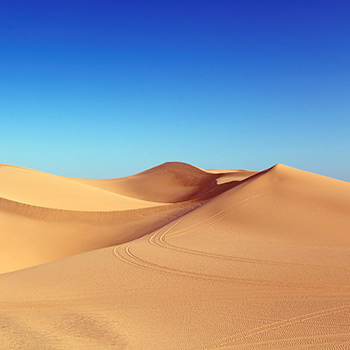
The image of a desert entirely covered with dunes represents only part of reality. Many deserts are dominated by rocky plateaus, gravel plains, mountains, or exposed rock surfaces.
The main desert landscapes include:
-
Ergs are vast expanses of sand and dunes.
-
Regs are plains covered with pebbles and gravel.
-
Hamadas are rocky plateaus almost entirely free of sand.
-
Wadis are riverbeds that are usually dry.
-
Salars and chotts are salt depressions where evaporation leaves a crust of salt.
Wind carries fine particles, polishes rocks, and shapes dunes. Dunes move when grains of sand are lifted on one side and deposited on the other. Rare but sometimes violent rains also carve gullies and transport large amounts of sediment.
Water in Arid Regions
Water is scarce, but it is not completely absent. It may be found in underground reservoirs, oases, temporary rivers, or nearby mountains.
Oases form when groundwater reaches the surface or can be drawn from an aquifer. They allow palm trees, crops, and villages to develop. They have long served as essential stops for caravans.
Wadis may remain dry for months or years. However, heavy rain can quickly turn them into dangerous torrents. Flash floods are among the main natural hazards in deserts.
Human populations have developed wells, reservoirs, canals, and underground galleries to collect and transport water while limiting evaporation.
Vegetation Adapted to Water Scarcity
Desert plants use different strategies to reduce water loss or take quick advantage of precipitation.
Some plants, such as cacti, store water in their stems. Their leaves have developed into spines, which reduce evaporation and protect them from herbivores. Cacti are native to the Americas, while other succulent plants play a similar role in Africa and Asia.
Other plants have long roots that reach underground water sources. Some species instead develop shallow roots that can quickly absorb water from a brief rainfall.
Leaves may be small, thick, waxy, or covered with fine hairs. Some plants lose them during the driest periods. Others live for only a few weeks: their seeds may wait several years before germinating after rainfall.
Desert Wildlife
Animals in arid regions must find water, avoid extreme heat, and tolerate major temperature differences. Many are nocturnal and remain hidden in burrows during the day.
Some of the best-adapted species include:
-
The dromedary can go for long periods without drinking and tolerate major water loss.
-
The fennec fox has large ears that help release heat.
-
The oryx can survive with very little water and tolerate a high body temperature.
-
The kangaroo rat obtains nearly all the water it needs from its food.
-
Snakes, lizards, and scorpions limit their activity during the hottest hours.
Desert animals often have light colouring that reflects part of the Sun’s radiation. Some have broad feet for walking on sand, while others reduce water loss by producing highly concentrated urine.
Human Populations
Deserts have been inhabited for thousands of years. Nomadic peoples traditionally moved their herds according to the seasons, grazing areas, and water availability.
The Tuareg, Bedouins, Mongols, San, and Indigenous peoples of Australia are among the populations associated with major arid regions. Their cultures rely on mobility, knowledge of the land, and careful use of resources.
Caravans long transported salt, gold, spices, textiles, and other goods. Camels and dromedaries made these long-distance journeys possible.
Today, people in desert regions live in both rural communities and large cities. Access to water, however, remains a constant challenge.
Agriculture and Livestock Farming
Agriculture is possible when water is available. Oases make it possible to grow dates, grains, vegetables, and fruit. Date palms provide shade and reduce evaporation for crops planted below them.
Modern irrigation has transformed some desert areas into farmland. However, it can deplete underground water supplies when water is removed faster than it is replenished.
Evaporation sometimes leaves salt in the soil. When this process continues, salinization reduces soil fertility and can make agriculture impossible.
Extensive livestock farming remains important in many semi-arid regions. Herds of goats, sheep, cattle, or camels move in search of grazing land.
Cities and Natural Resources
Several major cities have been built in desert environments. Their development often depends on dams, distant rivers, underground water reserves, or seawater desalination.
Deserts contain petroleum, natural gas, copper, iron, uranium, lithium, phosphate, and salt. Their extraction creates jobs, but it can also disturb fragile ecosystems.
Strong sunlight and vast open spaces also support solar energy production. Tourism attracts visitors to dunes, canyons, oases, and archaeological sites, but it sometimes increases water consumption and pressure on natural environments.
Desertification
Desertification is the degradation of land in arid, semi-arid, and dry subhumid regions. It does not always mean that a desert is advancing like a sea of sand. Instead, it refers to the loss of fertility, vegetation, and the soil’s ability to retain water.
Several factors can worsen it:
-
Overgrazing removes vegetation that protects the soil.
-
Deforestation exposes the land to wind and erosion.
-
Poor farming practices exhaust the soil.
-
Excessive irrigation can cause salinization.
-
Prolonged droughts reduce vegetation cover.
-
Climate change alters precipitation and increases evaporation.
Desertification threatens crops, grazing land, and water supplies. It can lead to poverty, food insecurity, and population displacement.
Protecting Arid Environments
Deserts recover slowly. A vehicle track, an uprooted plant, or compacted soil may remain visible for decades.
Land restoration may include planting native species, limiting grazing, stabilizing dunes, and improving irrigation methods. Rainwater collection and the protection of underground water reserves are also essential.
Parks and reserves help protect landscapes, wildlife, and cultural sites. The knowledge of local populations plays an important role in the sustainable management of water, grazing areas, and travel routes.
Quiz questions preview
-
An area of lush vegetation and freshwater in the middle of an arid desert environment.
Bayou | Wadi | Oasis | Mangrove -
Which animal is called the "Ship of the Desert"?
Goat | Llama | Camel | Yak -
What type of desert is Antarctica?
Polar desert | Cold desert | Stone Desert | Continental desert -
It is considered the world's oldest desert.
Gobi Desert | Thar Desert | Sahara Desert | Namib Desert -
What adaptation enables the sand snake to move efficiently in deserts?
Sidewinding | A powerful head | Removable scales | Its smooth skin

