Monopoly (U.S. Standard Edition) — Topic Guide
Monopoly is one of the best-known board games in the world. Its classic American edition turns Atlantic City into a setting for negotiation, investment and rivalry. Players buy properties, collect rent, build houses and attempt to remain solvent until their opponents go bankrupt.
Origins Older Than the Modern Game
Monopoly was inspired in part by “The Landlord’s Game,” designed by Elizabeth Magie in the early 20th century to illustrate the effects of land ownership and monopolies.
Several handmade versions later circulated among different groups of players. Street names and certain rules changed as the game was passed along. Charles Darrow eventually helped popularize a version based on Atlantic City, which Parker Brothers began marketing widely in 1935.
The game’s history therefore reflects the contributions of several people, even though Darrow was long presented as its main inventor.
Atlantic City on the Board
The properties in the classic American edition are mainly named after streets in Atlantic City, a seaside resort in New Jersey. The board does not, however, reproduce the city’s actual geography.
The streets are arranged according to increasing value. The least expensive properties appear shortly after “Go,” while prices and rents generally rise around the board. Boardwalk and Park Place form the dark blue group and are among the most expensive properties.
The Colour Groups
The streets are divided into colour groups. Owning every property in one group creates a monopoly and allows the player to build on them.
The classic board includes:
-
Two brown properties.
-
Three light blue properties.
-
Three pink properties.
-
Three orange properties.
-
Three red properties.
-
Three yellow properties.
-
Three green properties.
-
Two dark blue properties.
A player without a complete colour group can collect the basic rent but cannot build houses or hotels. The groups do not all have the same strategic value. Their purchase price, location and frequency of visits affect their profitability.
Railroads and Utilities
The American edition includes four railroads. Rent increases according to the number of railroads owned by the same player. One produces only a small return, while all four together can provide a steady income.
Electric Company and Water Works form the utilities. Their rent is calculated from the result of the dice. Buildings cannot be placed on these properties.
Houses and Hotels
Building greatly increases the rent charged on a property. Buildings must, however, be distributed evenly throughout a colour group.
A player must place one house on every property in the group before adding a second house to any of them. After four houses have been built on a property, they may be replaced with a hotel.
The number of buildings available from the bank is limited. Keeping several houses on one’s properties can therefore prevent opponents from building, adding another strategic element to the game.
Chance and Community Chest
“Chance” and “Community Chest” cards introduce unexpected events. They may move a token, award or remove money, send a player to jail or require payment for repairs.
Some cards direct a player to a property, railroad or specific space. They therefore influence how frequently certain sections of the board are visited.
Jail
A player can be sent to jail by landing on a particular space, drawing a card or rolling doubles three times in succession.
Being in jail does not prevent a player from collecting rent, negotiating, building or mortgaging properties. Early in the game, leaving jail quickly is usually preferable because unowned properties remain available. Later, remaining there temporarily can reduce the risk of landing on developed properties owned by opponents.
Auctions
When a player lands on an unowned property and refuses to buy it, the bank must normally put it up for auction.
Every player may bid, including the person who rejected the original purchase price. This rule distributes properties more quickly and helps shorten the game.
It may also allow a player to obtain a property for less than its listed price or force an opponent to spend more. Many games last unnecessarily long because this official rule is ignored.
Mortgages and Trades
A property can be mortgaged to the bank in exchange for money. It cannot collect rent while it remains mortgaged.
Trading is essential. Players may negotiate properties, cash and certain cards. An isolated property may have little value on its own but become extremely valuable when it completes a colour group.
A player must also consider what the opponent gains from the trade. Completing one monopoly while allowing another player to form an even more dangerous one may prove costly.
Free Parking and House Rules
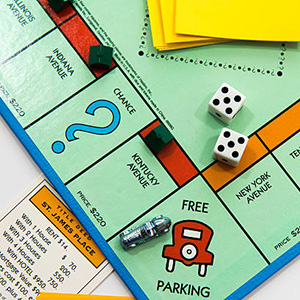
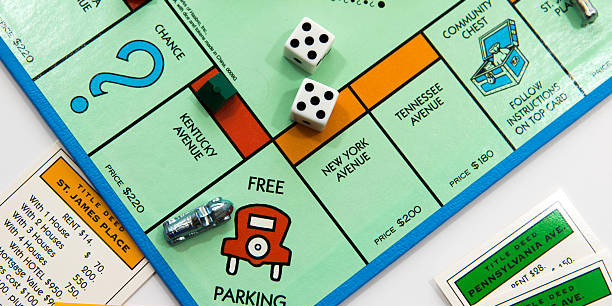
Under the official rules, “Free Parking” is simply a neutral space. A player receives no special payment for landing there.
A common house rule places taxes and fines in the centre of the board and awards the money to the next player who lands on Free Parking.
This variation adds more cash to the game and often makes it much longer. Players can avoid bankruptcy more easily, even though the official rules are designed to eliminate them gradually.
Managing Money
Owning many properties is not enough. Players must keep enough cash to pay rent, taxes and unexpected expenses.
Building too quickly can leave a player without sufficient funds. On the other hand, keeping all one’s money without developing monopolies limits potential income.
Effective money management requires balancing purchases, construction and a cash reserve. The positions of opponents on the board should also influence when a player chooses to build or negotiate.
Quiz questions preview
-
Name a pink property.
States Avenue | Ventnor Avenue | Tennessee Avenue | Indiana Avenue -
Name a dark blue property.
North Carolina Avenue | Atlantic Avenue | Park Place | States Avenue -
Which property has the highest rent without a house?
Pacific Avenue | Boardwalk | Pennsylvania Avenue | Park Place -
What is the first property from GO with a purchase price of $400?
Pennsylvania Avenue | Park Place | North Carolina Avenue | Boardwalk -
Name a green property.
Pennsylvania Avenue | Mediterranean Avenue | Atlantic Avenue | New York Avenue

