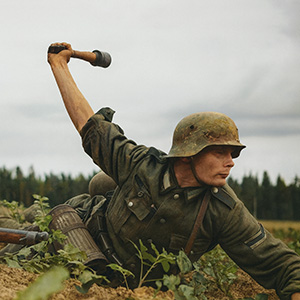
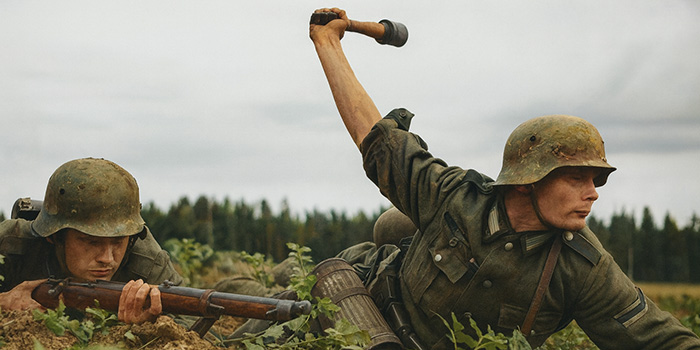
World War II - The Eastern Front — Topic Guide
From 1941 to 1945, the Eastern Front became the main land theatre of the Second World War. Nazi Germany and its allies fought the Soviet Union in a conflict of extreme violence, where military objectives were intertwined with territorial expansion, economic exploitation, and ideological extermination. From Operation Barbarossa to the Battle of Berlin, the struggle mobilized millions of soldiers and caused human losses unmatched on any other European front.
The Nazi-Soviet Pact
When the war began in September 1939, Germany and the Soviet Union were not yet enemies. A few days before the invasion of Poland, Adolf Hitler and Joseph Stalin had concluded the Nazi-Soviet Pact, a non-aggression agreement accompanied by a secret protocol dividing several territories in Eastern Europe into spheres of influence.
Germany attacked Poland from the west on September 1, while the Red Army invaded the eastern part of the country on September 17. Poland was eventually divided between the two powers. The Soviet Union then annexed the Baltic states and seized territories belonging to Romania, while also fighting Finland in the Winter War of 1939–1940.
For Hitler, however, this cooperation was only temporary. Nazi ideology had long presented Soviet communism as a major enemy and regarded the territories of the East as land destined for German expansion.
Operation Barbarossa
On June 22, 1941, Germany launched Operation Barbarossa and invaded the Soviet Union without a prior declaration of war. More than three million German soldiers took part in the offensive, supported by Romanian, Finnish, Hungarian, and other Axis forces. It was the largest land invasion ever launched up to that time.
Three major army groups advanced simultaneously. Army Group North moved toward Leningrad, Army Group Centre toward Moscow, and Army Group South toward Ukraine. The objective was to destroy the Red Army quickly, seize the Soviet Union’s main economic regions, and prevent the USSR from continuing the war.
The first weeks appeared to confirm German expectations. Armoured units broke through Soviet lines and encircled enormous enemy formations. Hundreds of thousands of Soviet soldiers were captured in battles such as Minsk, Smolensk, and Kyiv.
Soviet Weaknesses
The Red Army suffered catastrophic losses at the beginning of the invasion. Stalin’s Great Purges of the late 1930s had removed or imprisoned many experienced officers. The chain of command lacked flexibility, and many units were poorly prepared to respond to an attack on such a scale.
Stalin himself had refused for weeks to believe the numerous warnings of an imminent German offensive. When the invasion began, many Soviet formations were taken by surprise before they could adopt proper defensive positions.
Despite these disasters, the Soviet Union possessed advantages the Germans had underestimated: the vastness of its territory, a huge population, substantial industrial capacity, and human reserves capable of rebuilding entire armies even after enormous losses.
A War of Annihilation
On the Eastern Front, Germany was not conducting a conventional military campaign alone. Hitler regarded the conflict as an ideological and racial struggle intended to destroy “Judeo-Bolshevism” and conquer “living space” for the German people.
The usual rules of war were largely discarded. Captured Soviet political commissars were to be executed, while millions of Soviet prisoners of war were subjected to appalling conditions. Many died from starvation, disease, cold, or execution.
Behind the German armies came the Einsatzgruppen, mobile killing units tasked in particular with murdering Jews, communist officials, and other populations designated as enemies. Mass shootings were carried out across Eastern Europe. At Babi Yar, near Kyiv, tens of thousands of Jews were murdered within a few days in September 1941.
The Eastern Front thus became one of the main regions in which Nazi extermination policies were carried out.
The Siege of Leningrad
In the north, German forces reached the outskirts of Leningrad in 1941 but failed to capture the city. Rather than launching a direct assault, they sought to isolate it and force its surrender through starvation.
The siege lasted nearly 900 days. Residents suffered extreme shortages of food, fuel, and medicine, especially during the winter of 1941–1942. Hundreds of thousands of civilians died from hunger, cold, or bombardment.
The city nevertheless continued to resist. A supply route was maintained across Lake Ladoga, which froze during the winter. The siege was not fully lifted until January 1944.
The Battle of Moscow
In the autumn of 1941, Army Group Centre launched a major offensive toward Moscow. The Germans hoped that the capture of the Soviet capital would trigger political and military collapse.
The advance slowed, however, because of casualties, Soviet resistance, supply problems, and worsening weather. Autumn rains turned roads into mud, and winter arrived while many German soldiers were poorly equipped for extreme cold.
In December 1941, the Red Army launched a major counteroffensive. Units transferred in part from Siberia helped push German forces back from the approaches to Moscow. For the first time since the beginning of Barbarossa, the Wehrmacht suffered a major strategic defeat. The prospect of a quick German victory over the Soviet Union disappeared.
The German Offensive of 1942
After the failure before Moscow, Hitler concentrated the main effort of 1942 in the south. The goal was to reach the oil fields of the Caucasus, which were essential to the Soviet economy and potentially valuable to Germany, which faced serious energy shortages.
German forces advanced deeply into southern Russia. One part moved toward the Caucasus, while another advanced toward Stalingrad, a major industrial city on the Volga.
The division of forces, however, weakened the offensive. Stalingrad, which had initially been intended to secure the flank of the advance toward the Caucasus, gradually became a major symbolic objective, partly because it bore Stalin’s name.
Stalingrad
The Battle of Stalingrad began in earnest in the summer of 1942 and quickly became one of the most brutal battles of the entire war. The Luftwaffe heavily bombed the city, but the ruins created by the attacks then provided Soviet defenders with ideal terrain for close-quarters combat.
Soldiers fought for streets, buildings, factories, and sometimes individual floors of the same structure. The Red Army barely held positions on the western bank of the Volga while bringing reinforcements across the river.
In November 1942, the Soviets launched Operation Uranus. Rather than attacking the German forces directly inside the city, they struck the Romanian armies protecting their flanks. The lines collapsed, and the German 6th Army under General Friedrich Paulus was encircled.
Hitler refused to authorize a retreat. Attempts to supply the trapped troops by air failed, and a relief operation was unable to break the encirclement. Paulus surrendered at the end of January 1943, while the remaining German forces capitulated a few days later.
The defeat was an enormous shock for Germany. An entire army had been destroyed, and the Soviet Union had won a victory of immense military and symbolic importance.
Kursk and the End of Major German Offensives
After Stalingrad, Germany attempted to regain the initiative in the summer of 1943. Hitler chose to attack a large Soviet salient around the city of Kursk. The Soviets, well informed about the preparations, built several defensive belts filled with mines, trenches, and anti-tank positions.
Operation Citadel began in July. It led to enormous armoured clashes, often associated with the battle of Prokhorovka. German forces advanced only with great difficulty and failed to achieve the decisive breakthrough they had sought.
The offensive was eventually abandoned. After Kursk, Germany would never again regain lasting strategic initiative on the Eastern Front. The Red Army began an almost continuous advance that would eventually carry it to Berlin.
The Reconquest of Ukraine
From the second half of 1943 onward, Soviet forces steadily pushed the Germans westward. Kyiv was liberated in November, while major operations allowed the Soviets to recover most of Ukraine over the following months.
These campaigns were extremely costly. German forces sometimes used scorched-earth tactics, destroying infrastructure, industrial facilities, and resources during their retreats. Liberated territories also bore the marks of occupation, massacres, and the destruction of Jewish communities.
The Soviet advance nevertheless showed that the material balance of the war had changed completely. Soviet industry was now producing huge quantities of tanks, artillery, and aircraft, while American Lend-Lease aid supplied trucks, locomotives, food, and raw materials that greatly strengthened Soviet mobility and logistics.
Operation Bagration
In the summer of 1944, while the Western Allies were fighting in Normandy, the Red Army launched Operation Bagration in Belarus. The offensive became one of the greatest military disasters in German history.
The Soviets broke through the lines of Army Group Centre, destroyed or encircled numerous German formations, and advanced hundreds of kilometres. Minsk was liberated in early July, while Soviet forces moved steadily toward the borders of Poland and Germany.
Bagration demonstrated how profoundly the Red Army had changed since the disasters of 1941. It could now conduct vast operations combining infantry, armour, artillery, and air power while using deception and surprise to conceal the main axes of attack.
The Warsaw Uprising
In August 1944, as the Red Army approached Warsaw, the Polish resistance linked to the government-in-exile launched an uprising against the German occupiers. Its goal was to liberate the capital before Soviet forces arrived and thereby assert Poland’s political independence.
The insurgents initially controlled several districts, but the Germans responded with extreme brutality. Massacres were committed against civilians, while fighting gradually destroyed much of the city.
The Red Army remained for several weeks on the other side of the Vistula and did not provide the decisive aid the insurgents had hoped for. The reasons remain debated: Soviet forces had suffered heavy losses and their supply lines were stretched, but Stalin also had little interest in preserving a Polish resistance movement hostile to Soviet influence.
The uprising surrendered in October. Warsaw was then systematically destroyed by the Germans before their withdrawal.
Germany’s Allies Change Sides
The Soviet advance also transformed alliances in Eastern Europe. In August 1944, a change of government in Romania led the country to leave the Axis and declare war on Germany. Bulgaria also changed sides, while Finland concluded an armistice with the Soviet Union and was required to drive German forces from its territory.
Hungary remained aligned with Berlin for longer. When the Hungarian government attempted to withdraw from the war, Hitler intervened to keep a pro-German regime in power. Budapest became the site of a particularly bloody siege during the winter of 1944–1945.
The collapse of Germany’s allies exposed the borders of the Reich directly to the Soviet advance.
Entering Germany
In January 1945, the Red Army launched a massive offensive from the Vistula. German lines collapsed quickly, and Soviet forces advanced to the Oder, only a few dozen kilometres from Berlin.
This advance was accompanied by an enormous movement of civilians. Millions of Germans fled westward out of fear of the Red Army. Soviet soldiers, meanwhile, discovered evidence of Nazi crimes committed in the occupied territories and camps. Auschwitz was liberated by the Red Army in January 1945.
Violence also affected German civilians. Looting, executions, and widespread sexual violence were committed by Soviet troops in a context where years of Nazi brutality, destruction, and propaganda had generated an enormous desire for revenge.
The Battle of Berlin
In April 1945, the Red Army launched the final assault on Berlin. Soviet forces first had to break through German defensive positions at the Seelow Heights before gradually encircling the capital.
Inside the city, the defenders included regular soldiers, SS units, members of the Volkssturm, and even teenagers from the Hitler Youth. Fighting took place street by street through a city already devastated by bombing.
Hitler remained in his bunker beneath the Reich Chancellery and continued to issue orders to formations that no longer existed or were incapable of acting. On April 30, 1945, as Soviet troops approached the centre of Nazi power, he committed suicide with Eva Braun.
A few days later, Berlin surrendered. The Soviet flag raised over the Reichstag became one of the most famous images of victory over Nazi Germany.
The German Surrender
After the fall of Berlin, the new German government led by Admiral Karl Dönitz focused mainly on allowing as many soldiers and civilians as possible to surrender to the Anglo-Americans rather than to the Soviets.
The military surrender was signed at Reims on May 7, 1945, and came into effect the following day. A second ceremony was held in Berlin during the night of May 8–9 at Soviet insistence.
The war in Europe was over. For the Soviet Union, however, victory had come at a gigantic cost. Tens of millions of Soviet citizens, both military personnel and civilians, had died during the conflict.
The Decisive Front Against the Third Reich
For most of the war, the Eastern Front absorbed the majority of Germany’s land forces. Most Wehrmacht military losses were suffered there, along with a substantial share of its losses in tanks, aircraft, and equipment.
The Soviet Union therefore played a decisive role in destroying the military power of the Third Reich. This does not diminish the importance of the other fronts, Allied bombing, the naval war, or Western material aid, but the scale of the German-Soviet struggle was unmatched in Europe.
The Eastern Front was also where the war took its most radical form. Nazi racial ideology, the extermination of Jews, massacres of civilians, deliberate starvation, reprisals, destruction of cities, and the extreme brutality of combat gave the conflict a dimension far beyond conventional warfare.
From Barbarossa to Berlin, Germany went from an offensive that in 1941 appeared capable of destroying the Soviet Union within months to a retreat of thousands of kilometres that ended in the heart of its own capital. This transformation makes the Eastern Front essential for understanding not only Hitler’s defeat, but also the Soviet domination of Eastern Europe that emerged after 1945.
Quiz questions preview
-
Which country supplied Germany with the raw materials (oil, grain, minerals) it needed to attack the USSR?
Sweden | USSR | Turkey | Japan -
Which country was never involved on the Eastern Front during the German-Soviet conflict?
Hungary | Japan | Bulgaria | Romania -
Which Ukrainian City endured a 73-day siege before falling to Axis forces?
Kiev | Sevastopol | Kharkiv | Odessa -
In what order did these three battles, among the most decisive of the German-Soviet conflict, take place?
Moscow - Kursk - Stalingrad | Stalingrad - Moscow - Kursk | Kursk - Moscow - Stalingrad | Moscow - Stalingrad - Kursk -
What was the name of the army of the German Third Reich?
Schutzstaffel | Reichswehr | Wehrmacht | Abwehr

