On the Screen! James Bond — Topic Guide
A British secret agent working for MI6, James Bond travels around the world to prevent plots threatening governments, civilian populations, or international stability. A formidable spy, seducer, lover of fast cars, and connoisseur of refined products, he confronts megalomaniacal criminals with a combination of composure, elegance, and irony. Since the 1960s, his adventures have evolved with the times while retaining characters, objects, and expressions that have become icons of popular cinema.
The Origins of James Bond
-
James Bond was created by British writer Ian Fleming, who began writing his first novel, Casino Royale, in 1952 at his Jamaican residence called Goldeneye.
-
Published in 1953, Casino Royale introduces Bond as a British secret agent assigned to confront an enemy financier at the gambling table.
-
Producers Albert R. “Cubby” Broccoli and Harry Saltzman later adapted the character for the screen with Dr. No, released in 1962.
-
From Dr. No to No Time to Die, released in 2021, the official series consists of 25 films produced over nearly six decades.
Agent 007
-
James Bond carries the code number 007. The double zero indicates that he is authorized to kill while carrying out his missions.
-
He is generally presented as a former Royal Navy officer who became one of MI6’s most effective agents.
-
Bond is skilled with weapons, hand-to-hand combat, driving, skiing, diving, casino games, and several languages.
-
His apparent confidence conceals a solitary man who was orphaned as a child and is unable to lead a normal family life.
-
The phrases “Bond, James Bond” and “shaken, not stirred,” along with the tuxedo and the number 007, have become inseparable from the character.
-
The more recent films, particularly those starring Daniel Craig, explore his emotional wounds, mistakes, and the personal consequences of his profession in greater depth.
The Main Characteristics of the Films
-
Bond usually receives his mission from M, the head of MI6, before being given gadgets designed by the division led by Q.
-
His investigations take him to several countries and eventually reveal a plot far greater than the original mission suggested.
-
Bond’s enemies often possess immense wealth, a private organization, an advanced technological weapon, and a spectacular headquarters.
-
The action scenes feature car chases, stunts, fights, explosions, and journeys through international locations.
-
Humor, seduction, gadgets, and improbable situations play a greater or lesser role depending on the actor and the period.
-
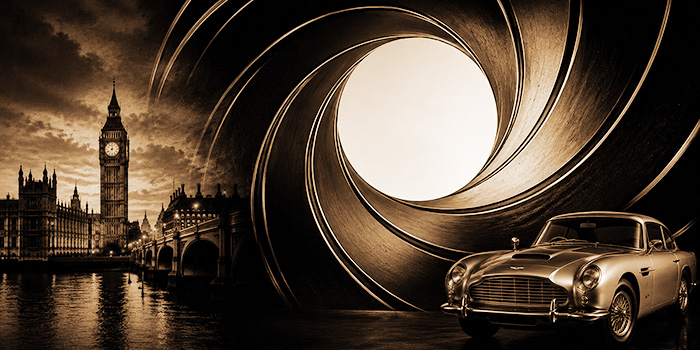
Stylized opening credits, the gun-barrel sequence, and an original theme song performed by a major recording artist also contribute to the identity of each film.
The Six Official James Bond Actors
-
Sean Connery was the first James Bond in the official film series. He established the character as dangerous, elegant, authoritative, and ironic in films such as Dr. No, From Russia with Love, and Goldfinger.
-
George Lazenby played Bond only once, in On Her Majesty’s Secret Service. The film presents a more vulnerable Bond who falls in love with and marries Tracy di Vicenzo.
-
Roger Moore portrayed Bond in seven films, from Live and Let Die to A View to a Kill. His version is distinguished by its humor, lightness, and spectacular adventures.
-
Timothy Dalton adopted a darker interpretation that was closer to the character imagined by Ian Fleming. He played Bond in The Living Daylights and Licence to Kill.
-
Pierce Brosnan combined Connery’s classical elegance, Moore’s humor, and modern action. He revived the franchise with GoldenEye in 1995 after a six-year break.
-
Daniel Craig portrayed a more physical, wounded, and emotionally complex Bond in five films forming a relatively continuous story, from Casino Royale to No Time to Die.
Some Essential Films
-
Dr. No established several of the series’ fundamental elements in 1962, including Sean Connery, the gun-barrel opening, Bond’s famous introduction, and exotic locations.
-
Goldfinger defined the classic formula through its memorable villain, Shirley Bassey theme song, gadgets, and Aston Martin DB5.
-
On Her Majesty’s Secret Service placed unusual emphasis on Bond’s emotions and ended with one of the most tragic events in the series.
-
The Spy Who Loved Me represents the height of the Roger Moore period with its enormous sets, amphibious car, and formidable villain Jaws.
-
GoldenEye adapted Bond to the post-Cold War world and introduced Pierce Brosnan, Judi Dench as M, and Sean Bean as a former 00 agent.
-
Casino Royale completely rebooted the series by presenting Bond’s beginnings as Agent 007 and his defining relationship with Vesper Lynd.
-
Skyfall combined spectacular action with a reflection on age, loyalty, Bond’s past, and the place of MI6 in the modern world.
Notable Actresses and Female Characters
-
Ursula Andress created one of the series’ first iconic images as Honey Ryder in Dr. No. Her arrival on a Jamaican beach in a white bikini remains a famous scene.
-
Honor Blackman played Pussy Galore in Goldfinger, a pilot who leads her own team and plays a decisive role in defeating the villain’s plan.
-
Diana Rigg portrayed Tracy di Vicenzo, the only woman Bond marries, in On Her Majesty’s Secret Service.
-
Jane Seymour, Barbara Bach, Carole Bouquet, and Grace Jones left their mark on the Roger Moore period as Solitaire, Anya Amasova, Melina Havelock, and May Day.
-
Famke Janssen played the dangerous Xenia Onatopp, while Michelle Yeoh portrayed Wai Lin, a Chinese agent as capable as Bond.
-
Sophie Marceau played Elektra King, one of the few female characters to serve as Bond’s principal adversary.
-
Halle Berry portrayed American agent Jinx in Die Another Day, a character designed as an action partner rather than simply someone Bond must rescue.
-
Eva Green played Vesper Lynd in Casino Royale. Her relationship with Bond explains much of his distrust and emotional coldness in the following films.
-
Léa Seydoux portrayed Madeleine Swann in Spectre and No Time to Die. She became one of the most enduring and important relationships in Bond’s life.
-
Ana de Armas played Paloma, a Cuban agent who made a strong impression despite her relatively brief appearance, while Lashana Lynch portrayed Nomi, an MI6 agent who assumed the 007 designation after Bond’s retirement.
M, Q, Moneypenny, and Bond’s Allies
-
M leads MI6 and assigns Bond his missions. The character has notably been played by Bernard Lee, Robert Brown, Judi Dench, and Ralph Fiennes.
-
Judi Dench gave M exceptional authority and an almost maternal relationship with Bond. She retained the role for seven films, from the beginning of the Pierce Brosnan era through Skyfall.
-
Q leads the department responsible for technical equipment. Desmond Llewelyn played the character in 17 films and remains the actor most closely associated with the role.
-
John Cleese briefly took over as Q before Ben Whishaw introduced a younger, computer-oriented version during the Daniel Craig period.
-
Miss Moneypenny, M’s secretary and Bond’s friend, has notably been played by Lois Maxwell, Samantha Bond, and Naomie Harris.
-
American CIA agent Felix Leiter regularly appears as Bond’s ally. Jeffrey Wright gave the character particular importance during the Daniel Craig era.
The Main Villains
-
Auric Goldfinger, played by Gert Fröbe, plans to increase the value of his gold by contaminating the American reserves at Fort Knox.
-
Ernst Stavro Blofeld, leader of the organization SPECTRE, is Bond’s most famous recurring enemy. He has been played by several actors, including Donald Pleasence, Telly Savalas, and Christoph Waltz.
-
Francisco Scaramanga, played by Christopher Lee, is a professional assassin who uses a golden gun.
-
Jaws, played by Richard Kiel, is an almost indestructible giant with metal teeth.
-
Alec Trevelyan, portrayed by Sean Bean in GoldenEye, is a former Agent 006 seeking revenge against Britain.
-
Le Chiffre, played by Mads Mikkelsen, finances criminal organizations and confronts Bond during a poker game in Casino Royale.
-
Raoul Silva, portrayed by Javier Bardem in Skyfall, is a former agent pursuing a personal vendetta against M.
-
Christopher Walken, Robert Carlyle, Mathieu Amalric, Rami Malek, and Christoph Waltz are also among the actors who have portrayed major Bond villains.
The Cars, Gadgets, and Style
-
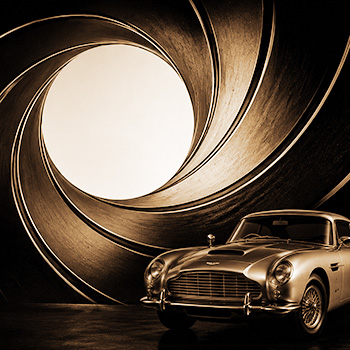
The Aston Martin DB5, first seen in Goldfinger, became the most famous car in the series and returned in several later films.
-
Bond has also driven Lotus, BMW, Bentley, and various Aston Martin models equipped with weapons, defensive devices, and ejection systems.
-
The gadgets designed by Q include explosive watches, miniature cameras, remote-controlled vehicles, concealed weapons, and tracking devices.
-
Some gadgets are deliberately extravagant, while the Daniel Craig films generally favor more believable technology.
-
The suits, watches, drinks, hotels, casinos, and luxurious destinations contribute to the image of elegance and refinement associated with Bond.
The Music of James Bond
-
The famous James Bond instrumental theme first appeared in Dr. No. Composed by Monty Norman and arranged by John Barry, it has accompanied many scenes and trailers ever since.
-
John Barry composed the scores for several films and helped establish the franchise’s powerful and mysterious orchestral style.
-
Shirley Bassey is the singer most closely associated with Bond through the songs Goldfinger, Diamonds Are Forever, and Moonraker.
-
Paul McCartney and Wings, Carly Simon, Duran Duran, a-ha, Tina Turner, Madonna, and Garbage also performed main theme songs for the series.
-
Adele, Sam Smith, and Billie Eilish won the Academy Award for Best Original Song for Skyfall, Writing’s on the Wall, and No Time to Die.
-
Bond songs have become a genre of their own, generally combining dramatic orchestration, powerful vocals, and lyrics dealing with danger, seduction, or betrayal.
The Evolution of the Franchise
-
The earliest films were shaped by the Cold War, although the producers often avoided directly identifying the Soviet Union as the principal enemy.
-
The Roger Moore period placed greater emphasis on humor, gadgets, and spectacular adventures influenced by the popular trends of the time.
-
Timothy Dalton brought Bond back to a more brutal form of espionage, while Pierce Brosnan had to demonstrate that the character remained relevant after the collapse of the Soviet Union.
-
The Daniel Craig era introduced stronger continuity between the films and made Bond’s relationships with Vesper Lynd, M, and Madeleine Swann central to his personal journey.
-
In March 2025, Amazon MGM Studios obtained creative control of the franchise under a new arrangement in which the company, Michael G. Wilson, and Barbara Broccoli remained co-owners. The transition ended several decades during which the Broccoli family directly controlled the artistic direction of the films.
Quiz questions preview
-
In what year did the film "The World Is Not Enough" be released?
1999 | 1997 | 1995 | 2000 -
In which film is the Venice International Chess Championship shown?
Diamonds Are Forever | From Russia With Love | For Your Eyes Only | Casino Royale -
Where did actor Roger Moore come from?
Ireland | France | England | Switzerland -
Who directed the film "No Time to Die" released in 2021?
Cary Joji Fukunaga | Mike Leigh | Roger Michell | Nick Park -
Who directed the 1973 film "Live and Let Die"?
Guy Hamilton | Nicolas Roeg | Mike Hodges | Michael Winner

